
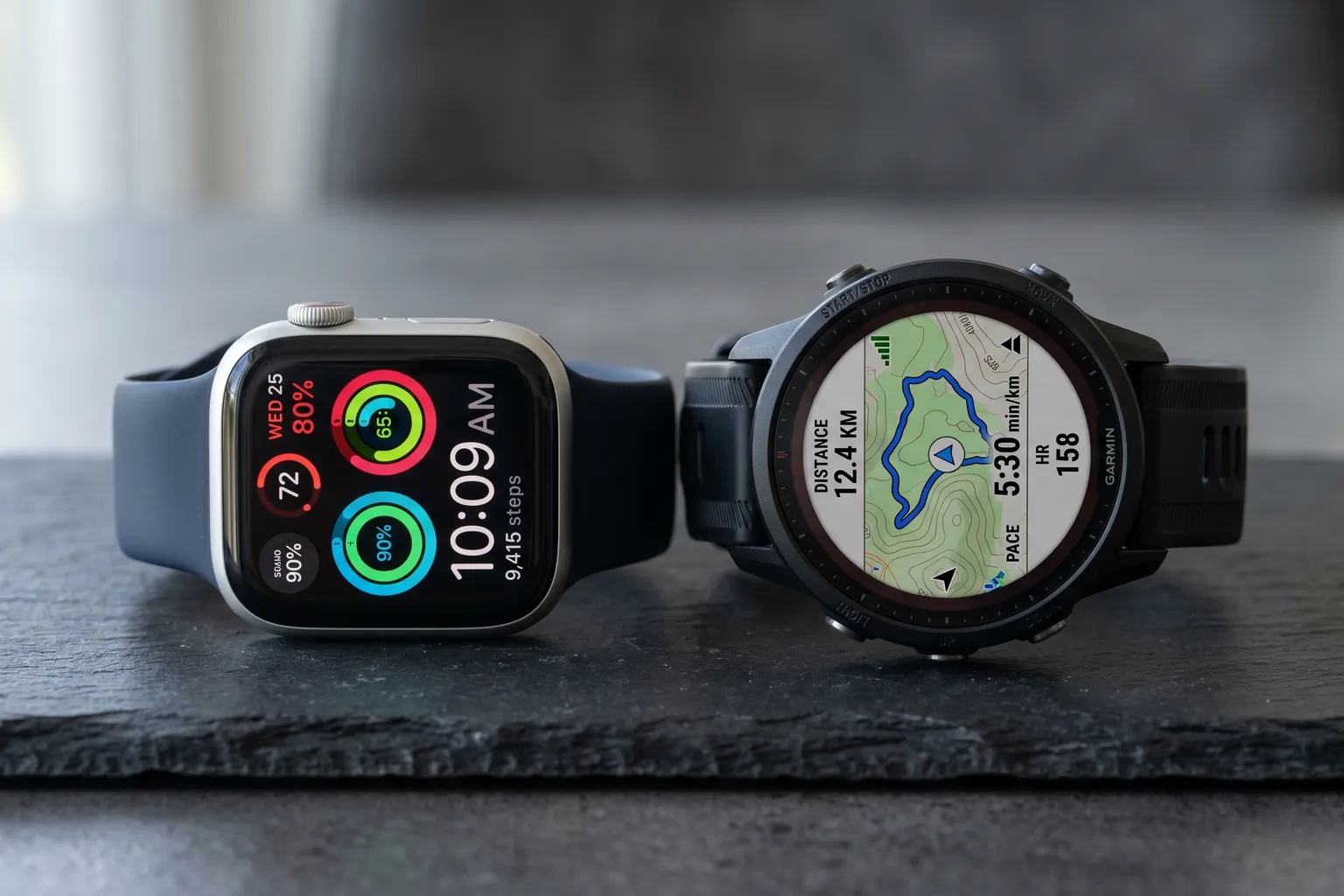
The Apple Watch vs. Garmin debate is one of those “wrong question” situations — they’re not really the same product.
Apple Watch is a smartwatch with good fitness tracking. Garmin is a fitness tracker with some smartwatch features. Which one’s right for you depends entirely on which of those priorities comes first.
Let me make it concrete.
The Core Tradeoff in One Paragraph
Choose Apple Watch if: you have an iPhone, you want a single device for notifications, payments, calls, apps, and health — and you’re willing to charge it every night.
Choose Garmin if: fitness data is your primary motivation, battery life matters more than smartwatch features, or you’re training for a specific athletic goal.
If you’re still reading, you need more detail. Here it is.
Battery Life: Garmin Wins, No Contest
| Device | Battery (Normal Use) | Battery (GPS On) |
|---|---|---|
| Apple Watch SE 3 | ~18 hours | ~5 hours |
| Apple Watch Series 10 | ~18 hours | ~8 hours |
| Garmin Forerunner 265 | 13 days | 6 hours |
| Garmin Fenix 8 | 19 days | 16 hours |
| Garmin Venu 3 | 14 days | 9 hours |
Apple Watch: charge every night, full stop. This isn’t negotiable or improvable — it’s the fundamental architecture. Apple Watch is optimized for the iPhone ecosystem, not battery life.
Garmin: charge it twice a week on a Forerunner 265, or once every two weeks on a Fenix 8. This changes how you use the device entirely. You can wear it for sleep every night (improving sleep data quality), you never have battery anxiety before a long run, and you stop thinking about it as something that needs daily maintenance.
For runners doing long sessions, the Forerunner 265’s GPS mode lasts 6 hours — enough for a marathon or a long trail run. The Fenix 8’s 16-hour GPS mode covers ultramarathons.
Fitness Tracking: Garmin Wins on Depth
Both track steps, heart rate, GPS routes, calories, and sleep. But Garmin goes significantly further on athletic metrics.
What Garmin adds:
Training Load and Acute/Chronic Load Balance. Garmin calculates your training load (how hard you trained recently) and compares it to your chronic load (how hard you’ve been training over time). This ratio predicts injury risk. When you’re pushing above your chronic load, Garmin flags it. This is the kind of data that coaches track manually; having it automated is genuinely useful.
VO2 Max tracking with accuracy. Both Apple Watch and Garmin estimate VO2 max. Garmin’s estimate is more accurate and tracks trends over time more precisely. Garmin also provides a VO2 max comparison by age group — which is motivating in a numbers-nerd way.
Body Battery. Garmin’s energy level score combines sleep, stress, HRV, and activity to give you a 0–100 readiness score. It’s more reliable than resting heart rate alone as a measure of how ready you are to train hard.
Recovery Advisor. After a hard session, Garmin tells you specifically how many hours to wait before training hard again. It factors in session intensity, your fitness level, and current Body Battery.
Race Predictor. Based on your recent runs, Garmin predicts your 5K, 10K, half, and marathon times. It’s not magic — it’s based on your VO2 max estimate — but it’s a useful planning tool.
What Apple Watch does better:
Ecosystem integration. Activity Rings, Apple Health, and third-party app integration are seamless in a way Garmin’s Garmin Connect app isn’t quite. If you use MyFitnessPal, Strava, or any Apple Health-compatible app, Apple Watch feeds data automatically.
Clinical health monitoring. Apple Watch has FDA-cleared ECG and AFib detection that goes beyond what most Garmin models offer. Sleep Apnea detection on Series 10 is new and potentially significant for users who suspect sleep disordered breathing. These are medical-grade features, not fitness-grade.
Crash Detection and Emergency SOS. These safety features have real-world utility that has nothing to do with fitness.
Smartwatch Features: Apple Watch Wins
| Feature | Apple Watch | Garmin |
|---|---|---|
| Apple Pay | ✓ | ✗ |
| App Store | ✓ (full) | Limited |
| Siri | ✓ | ✗ |
| Call + text from wrist | ✓ (with cellular) | Notifications only |
| Maps turn-by-turn | ✓ | Basic navigation |
| Spotify / Music streaming | ✓ | Music storage only |
| Third-party app ecosystem | Large | Small |
Apple Watch is the better smartphone companion. Period. If you want to leave your phone at home and still have full functionality — making calls, using apps, making payments — Apple Watch with cellular is the answer.
Garmin is not a smartwatch in the same sense. It shows notifications and lets you control music playback, but it’s not running apps or making calls. That’s not a failure — it’s a design choice that’s why the battery lasts 13 days.
Head-to-Head: Apple Watch Series 10 vs Garmin Forerunner 265
Apple Watch Series 10 on Amazon → | ~$399–499
Garmin Forerunner 265 on Amazon → | ~$299
Both have AMOLED displays. Both have built-in GPS. Both track health metrics comprehensively. Where they diverge:
- Battery: Forerunner 265 = 13 days vs. Series 10 = 18 hours
- Training analytics: Forerunner 265 » Series 10
- Smartwatch features: Series 10 » Forerunner 265
- Health monitoring (clinical): Series 10 has sleep apnea detection and FDA-cleared ECG
- Price: Forerunner 265 is actually $100 cheaper
For pure running performance, the Forerunner 265 is the better device at the lower price. For everything else — payments, apps, calls, ecosystem — Series 10 wins.
Head-to-Head: Apple Watch SE vs Garmin Venu 3
Apple replaced the SE 2nd Gen with the SE 3, adding an Always-On Display and sleep apnea notifications that the 2nd Gen didn’t have, plus 2x faster charging.
Apple Watch SE 3 on Amazon → | ~$225
Garmin Venu 3 on Amazon → | ~$349
The SE is $100 cheaper than the Venu 3. But look at what you’re comparing:
- Battery: Venu 3 = 14 days vs. SE = 18 hours
- Fitness ecosystem: Venu 3 has better training data
- Smartwatch ecosystem: SE is far more capable as a smartwatch
- Sleep tracking: Venu 3 wins (because you can actually wear it to sleep without sacrificing charging time)
If your priority is fitness tracking: Venu 3. If your priority is smartwatch functionality + iPhone integration: Apple Watch SE.
The Garmin Fenix 8: For Serious Athletes
Garmin Fenix 8 on Amazon → | ~$700–900
I’m including the Fenix 8 because it’s the watch that makes the Apple Watch comparison almost irrelevant. The Fenix 8 is a purpose-built multisport GPS watch for serious athletes.
19 days of battery. Multi-band GPS accuracy (4x more satellite systems than standard GPS). Dive-rated to 40m. LED flashlight. Training load, VO2 max, race predictor, advanced HRV, heat and altitude acclimatization.
At $700–900, the Fenix 8 is not competing with Apple Watch. It’s competing with dedicated cycling computers and triathlon watches. If you’re training for an Ironman, trail ultra, or any event requiring multi-day GPS tracking, this is the instrument for it.
My Take: Who Should Buy What
iPhone user, casual fitness goals, want it all in one device: Apple Watch Series 10 or SE. You’ll compromise on battery; everything else is excellent.
Android user: Don’t buy Apple Watch. Samsung Galaxy Watch 7 is the better choice for Android.
Serious runner or cyclist: Garmin Forerunner 265 or Fenix 8. The training data gap is real and it matters if performance is your goal.
Want sleep tracking with no charging compromise: Garmin wins here. You cannot meaningfully track sleep on Apple Watch because it competes with the nightly charge.
Use both: Not a cop-out answer — plenty of people wear a Garmin during exercise (for GPS accuracy and training data) and Apple Watch for daily smartwatch use. It’s redundant and expensive, but if both use cases are important, it’s actually the right answer.
For more on fitness wearables, check out our Best Fitness Trackers of 2026 roundup, where we cover 10 options at every price point. If neither Apple Watch nor Garmin fits because sleep and recovery are your primary goal — and you’d rather not wear any watch to bed — our Oura Ring 4 review covers the ring-form alternative that’s become the go-to for HRV tracking and deep sleep data.