
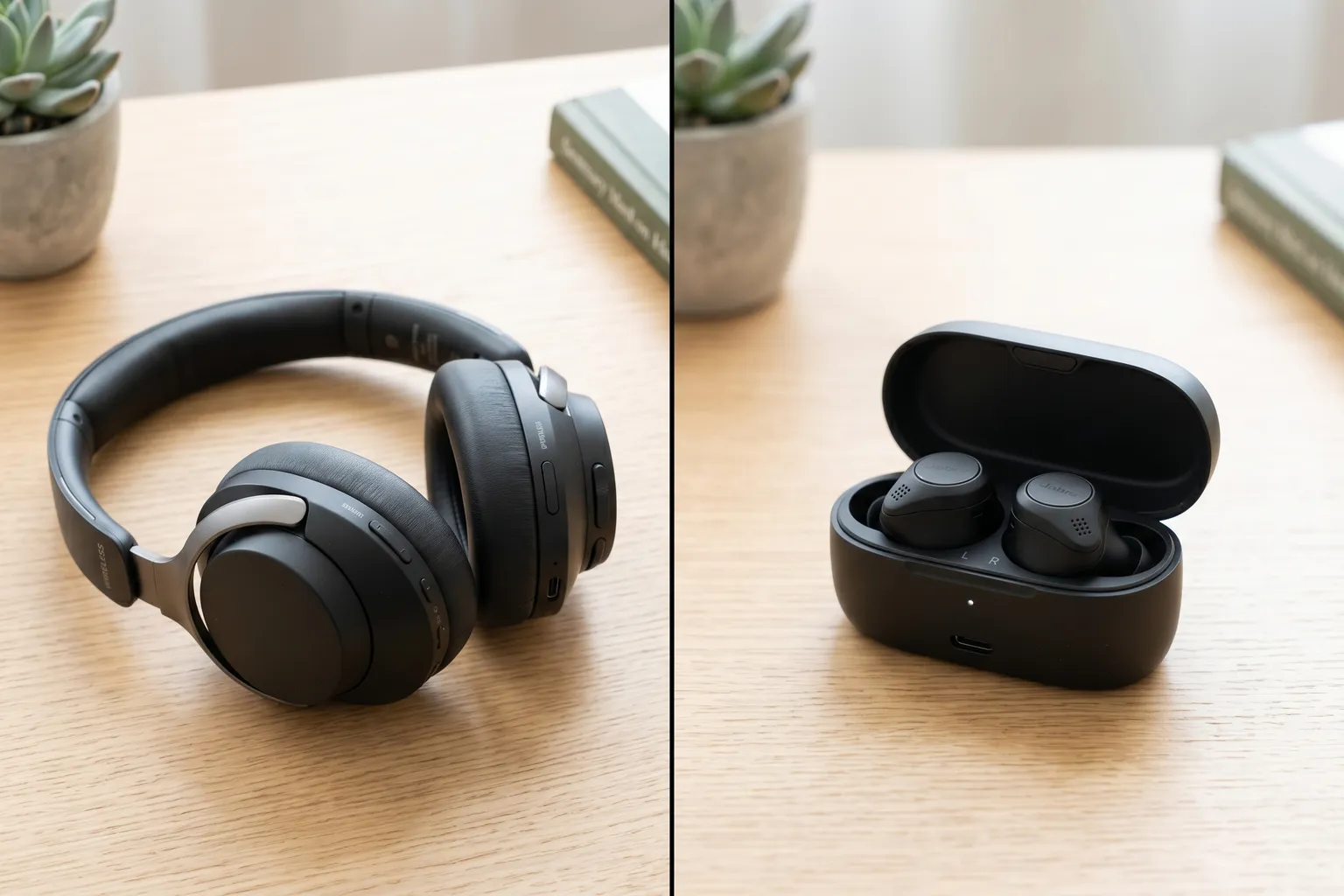
// PROS
- Clear use-case-based recommendations rather than spec sheets
- Covers both budget and premium picks in each category
- Honest about when 'both' is the right answer
- Direct top picks with concrete models named
- Practical comparison table for quick reference
// CONS
- Doesn't dive deep into individual model differences
- Limited discussion of codec support or technical audio specs
- No coverage of warranty or customer support experiences
TL;DR: Get earbuds if: you’re mobile, commute, gym, need something inconspicuous, or share a living space. Get headphones if: you’re at a desk, need maximum ANC, care about sound quality, do long focused sessions, or produce/mix audio. Both are the right answer for different people — the question is your actual use case, not a spec comparison.
The earbuds vs headphones question gets asked constantly, and it gets answered badly just as often. The typical answer is either “it depends” (useless) or a feature spec comparison that ignores the actual question: what’s right for my life and my use case?
I’m going to skip the feature comparison table as the lead. Instead: here’s what each one actually does well, and a direct “buy this if” section at the end. Then the comparison data if you want to dig into specifics.
What Earbuds Are Actually Good At
Portability. This is the obvious one, but it deserves elaboration. True wireless earbuds go in a pocket. They weigh 5-7 grams each. You can run in them, sleep in them (some people do), wear them under a helmet, and forget they’re there. No headphone achieves this.
Not looking weird in public. Social context matters. Wearing over-ear headphones on a bus looks normal. Wearing them at a coffee shop looks normal. Wearing them in a meeting looks like you’re making a statement. Earbuds are inconspicuous in more contexts.
Gym and exercise. Headphones with wires are a liability during exercise. Big over-ear cups trap heat and sweat. True wireless earbuds — especially those with wing tips — are the standard for active use.
Calls and voice. Modern earbuds have 4-6 microphones with beamforming and AI noise reduction. Call quality on premium earbuds (Jabra, AirPods Pro) is excellent. The mic positioning is better for calls than most headphones, which use a mic on the side of the cup at some distance from your mouth.
Fall-asleep use. Some people fall asleep to podcasts or music. Earbuds work for this. Headphones don’t, unless you’re in a very specific sleep position.
What Headphones Are Actually Good At
ANC performance. Over-ear headphones create passive isolation before ANC activates — the cups physically block sound. Then ANC works on top of that. The Sony WH-1000XM6 and Bose QuietComfort Ultra eliminate noise in a way earbuds approximate. If you need to concentrate in a loud environment, flagship headphones still win.
Sound quality and soundstage. Larger drivers, larger acoustic chambers, better imaging. At equivalent price points, over-ear headphones typically reproduce audio with more space and nuance than in-ear earbuds. Open-back headphones in particular create soundstage that no earbud can replicate.
Long sessions without fatigue. Velour-padded over-ear cups don’t press against your ear canal. For 6-8 hour sessions (work, travel, focused creative work), many people find headphones more comfortable than earbuds that sit in their ear for hours.
Battery life. Headphones have more physical space for batteries. The Sony WH-1000XM6 runs 30 hours. The JBL Tune 770NC runs 70 hours. No earbud matches those numbers — most earbuds do 6-10 hours per charge, then need the case. For long travel without charging access, headphones have the advantage.
No connection anxiety. Headphones are one device. True wireless earbuds are two devices that need to sync with each other and your source. Modern earbuds are reliable, but “left earbud disconnected” is still a thing that happens. Headphones don’t have this problem.
Head-to-Head: The Actual Comparison
| Factor | Earbuds | Headphones |
|---|---|---|
| Portability | Excellent — pocket-sized case | Moderate — folded, bag-required |
| Sound quality (budget) | Decent | Better |
| Sound quality (premium) | Excellent | Excellent |
| ANC | Very good (AirPods Pro 2, XM5) | Best (XM6, QC Ultra) |
| Battery per charge | 6-10 hrs | 20-70 hrs |
| Total battery with case | 20-40 hrs | N/A (no case) |
| Call quality | Very good to excellent | Good to very good |
| Gym/exercise | Excellent | Poor |
| Long session comfort | Mixed (ear canal pressure) | Generally better |
| Price range | $20-350+ | $40-500+ |
| WFH/desk use | Fine | Better |
Buy Earbuds If…
You commute. Earbuds fit in a coat pocket. You pull them out on the subway, put them back when you arrive. No bag required. Compact cases protect them from pocket damage.
You exercise. Wireless earbuds with wing tips (Beats Fit Pro, Jabra Elite 8 Active) handle movement in ways headphones can’t. Sweat ratings on good running earbuds are IPX7+.
You share a living space and don’t want to look antisocial. Earbuds are less visible. You can wear one earbud in a conversation without an awkward “let me take these off” moment.
You take a lot of calls. Premium earbud mics (Jabra specifically) are calibrated for phone and video call use. Small form factor helps with call positioning.
Portability is the constraint. If you travel light, exercise regularly, or work from multiple locations, earbuds are the flexible pick.
Top pick for earbuds: Sony WF-1000XM5 ($300) for premium. Sony WF-C500 ($45) for budget.
Buy Headphones If…
You work at a desk in a noisy environment. Over-ear headphones with ANC are the productivity tool here. Block the open office, the coffee shop, or the noisy household. The Sony WH-1000XM6 and Bose QuietComfort Ultra are the options people actually use to get work done in noise.
You care about audio quality. Home listening, gaming with spatial audio, music production — over-ear headphones at equivalent prices give you more acoustic space to work with.
You fly more than twice a year. Airplane cabin noise is exactly what over-ear ANC headphones are built for. 10-12 hours of noise elimination on a transatlantic flight changes the experience. Earbuds are good, not as good.
You do long-session focused work. Writers, programmers, researchers — people who put on headphones and don’t take them off for 4-6 hours often find over-ear headphones more comfortable for marathon sessions.
You want maximum battery. The JBL Tune 770NC has 70-hour battery under $100. Nothing in the earbud category comes close.
Top pick for headphones: Sony WH-1000XM6 ($399) for premium ANC. Anker Soundcore Space One ($80) for budget.
Anker Soundcore Space One on Amazon
The “Both” Answer (and When It’s Right)
A lot of people end up with both. Headphones for desk work and serious listening. Earbuds for gym, commuting, and casual use. If your budget allows it, this is actually the optimal setup — you’re using the right tool for each situation.
If you can only have one: think about where you spend the most time using audio. Desk worker: headphones. Active commuter: earbuds. Both equally: start with earbuds because they’re more versatile.
Related Guides
If you’ve decided:
- Best noise cancelling headphones — flagship ANC headphones compared
- Best headphones under $100 — budget headphone picks
- Best budget earbuds — earbuds under $60 that work
- Best earbuds for running — if exercise is the use case