
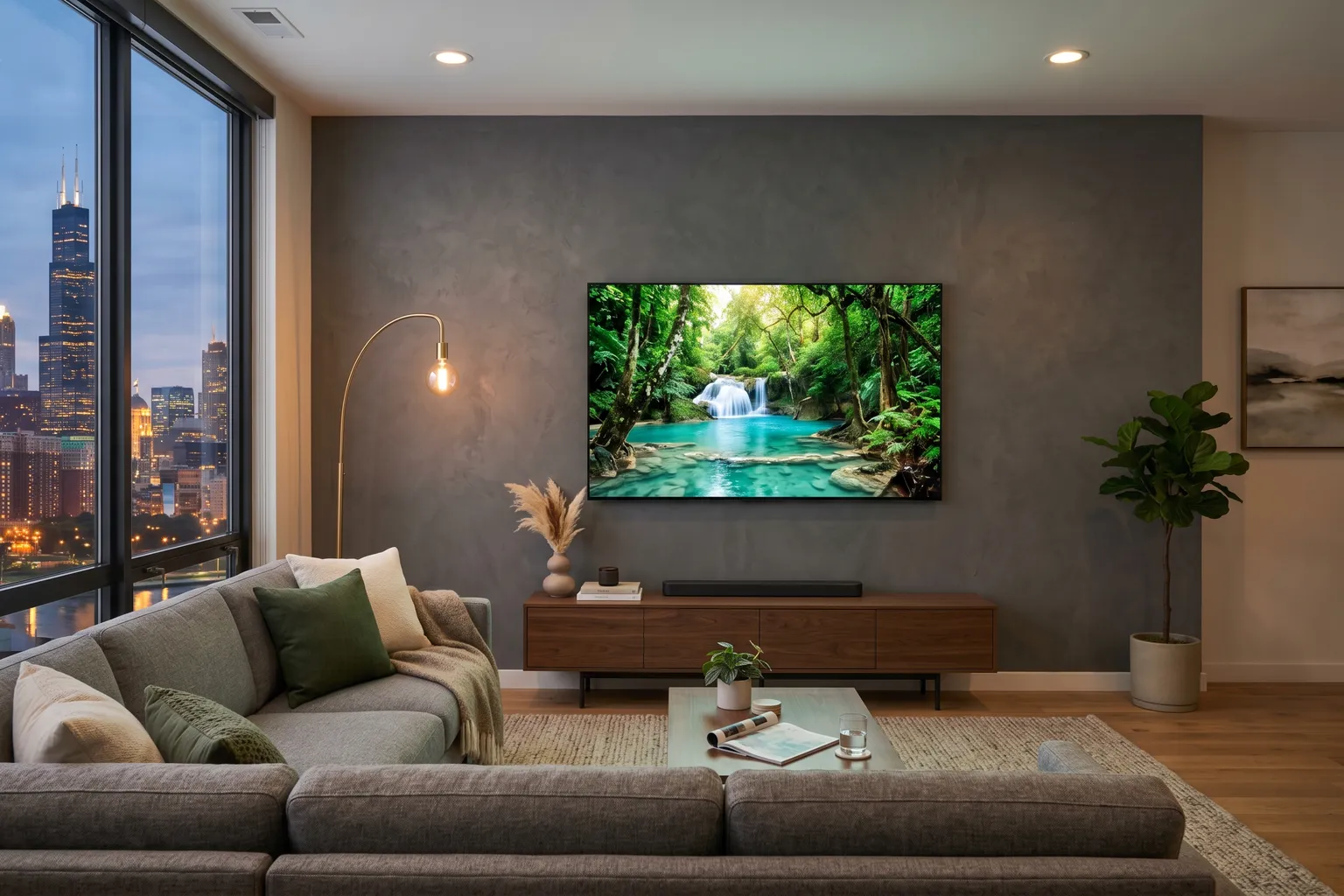
- The LG C3 OLED is the best 65-inch TV you can buy at around $1,300 — perfect blacks, 120Hz, and HDMI 2.1 across all four ports.
- If you're in a bright room with lots of windows, the Hisense U7 ($800-850) or Samsung QN90F Neo QLED will outperform any OLED on the wall.
- Don't sleep on the TCL QM6K — at around $500, it punches well above its price and has no real competition in the budget segment.
- The LG G3 is the absolute best picture quality available in a 65-inch panel, but you're paying a serious premium for brightness most rooms don't need.
- Vizio still makes sense on a tight budget, but ink is drying on their lineup — check availability before committing.
Sixty-five inches is the sweet spot. Not because I said so – because the market agrees. It’s the size where you get a genuinely immersive picture without rearranging your living room, and it’s the size where manufacturers put their best panels at competitive prices.
The hard part isn’t finding a 65-inch TV. There are dozens of them. The hard part is figuring out which ones are actually worth owning and which are spec-sheet TVs that look great on a display card and terrible on your wall.
I’ve been evaluating and recommending TVs for over a decade, first for IT procurement (where you’re buying 40 displays at a time and can’t afford a bad choice), and now for anyone who’ll listen. What I care about: does the picture look good under real viewing conditions, does it hold up over time, and does it do what it’s supposed to do without getting in your way?
Here are eight 65-inch TVs worth buying in 2026 – organized from best overall down to smart budget buys.
Quick Comparison Table
| TV | Panel Type | Price (approx.) | Best For | Refresh Rate |
|---|---|---|---|---|
| LG C3 OLED 65" | OLED | ~$1,200 | Best overall | 120Hz |
| Samsung QN90F Neo QLED 65" | Mini-LED LCD | ~$1,559 | Bright rooms | 165Hz |
| TCL QM6K 65" | Mini-LED QLED | ~$500 | Best budget | 120-144Hz |
| Sony BRAVIA 3 II 65" | Full Array LED | ~$806 | Streaming/streaming apps | 120Hz |
| LG C4 OLED 65" | OLED | ~$1,500 | Upgrade from C3 | 120Hz |
| Hisense U7 65" | Mini-LED ULED | ~$848 | Value premium | 165Hz |
| Samsung S90F OLED 65" | OLED | ~$1,200 | Samsung OLED | 144Hz |
| Toshiba M450 QLED 65" | QLED LCD | ~$380 | Tight budget | 120Hz |
1. LG C3 OLED 65" — Best Overall
LG C3 OLED 65" — ~$1,200
This is the one. Not because it’s the most expensive – it isn’t – or because it has the best spec sheet. It’s the best because it does everything well and nothing poorly.
The C3 uses LG’s OLED evo panel with the Alpha 9 Gen6 AI processor. What that means in practice: true blacks, colors that hold up across a wide range of content, and a 120Hz refresh rate with G-Sync compatibility and FreeSync Premium Pro. All four HDMI ports are HDMI 2.1 – something you won’t find on cheaper TVs that hide one or two 2.0 ports in the spec sheet. That matters if you’re running a PS5, Xbox Series X, or a high-end PC to this screen.
The input lag spec is 1.1ms in game mode. That’s effectively zero. You won’t feel it.
Where does it fall short? Brightness. OLED panels can’t hit the peak brightness numbers that Mini-LED TVs can. In a dark room, none of that matters – the C3 is stunning. In a living room with afternoon sunlight coming through untreated windows? You’ll notice. The Hisense U7 or Samsung QN90F will look better under those conditions.
But for most people, in most rooms, with the lights off or controlled, the C3 is the honest best answer at this price. Its picture quality has genuinely narrowed the gap with the more expensive G3 and C4, and you’re not giving up anything meaningful for everyday use.
2. Samsung QN65QN90F Neo QLED — Best Non-OLED TV
Samsung QN65QN90F Neo QLED 65" — ~$1,559
The Neo QLED argument is simple: more brightness than OLED will ever give you, with Mini-LED local dimming that’s actually good enough to compete on contrast.
Samsung’s Neo QLED uses thousands of tiny LED zones to control backlight dimming. It’s not pixel-perfect like OLED – you’ll occasionally see blooming (halos) around bright objects on dark backgrounds if you look for them. But in normal viewing, especially during sports, daytime TV, or HDR content in a lit room, the QN90F is the better-looking TV.
Glare-free screen coating handles bright windows and overhead lighting. The NQ4 AI Gen2 processor upscales everything to 4K using 128 neural networks. 165Hz with VRR support up to 4K. All four HDMI 2.1 ports.
The price is the issue. At ~$1,559, this is still meaningfully more than the LG C3 for a picture that’s better in some scenarios and worse in others. If you’re committed to a bright room setup and gaming matters, it’s worth considering. But honest take: unless brightness is your top priority, the C3 wins the value argument pretty easily.
3. TCL 65" QM6K — Best Budget Pick
TCL QM6K 65" — ~$500
TCL’s QM6K is the budget recommendation I’d actually make to someone I know.
Mini-LED QLED. 120 to 144Hz. Dolby Vision IQ and Dolby Atmos. Google TV built in, which means you’re not dependent on a sluggish proprietary interface. At around $500 for a 65-inch Mini-LED TV, the QM6K does things that would have cost twice as much two years ago.
It’s not perfect. The local dimming doesn’t match Samsung’s Neo QLED or Hisense’s U7. Colors can be oversaturated out of the box – calibration helps. The built-in speakers are functional, not great (but that’s true of basically every TV at this price).
For streaming Netflix, Disney+, and HBO Max in a typical living room, the QM6K is going to look better than people expect. And at $500, if it’s the number you need to work with, this is the TV I’d tell you to buy without hesitation.
4. Sony BRAVIA 3 II 65" — Best for Streaming
Sony BRAVIA 3 II 65" — ~$806
Sony replaced the X90L naming with its BRAVIA lineup, and the BRAVIA 3 II carries the same XR Processor logic forward: AI scene recognition adjusting color, contrast, and clarity frame by frame, plus XR Clear Image working to restore detail and cut noise in lower-quality streams rather than just upscaling by the numbers.
Anti-glare screen coating comes standard at 65 inches, which matters more than it sounds like it should if your living room gets afternoon sun. Sony throws in a real perk here too: Sony Pictures Core access with five credits toward new releases and a year of hundreds of classics included with the TV, plus Dolby Vision, Dolby Atmos, and DTS:X support.
This is a step down in price from the old X90L, and it reads that way in tier rather than a straight upgrade – Google TV is now Google TV with Gemini built in, which is the more meaningful software change. For people who stream more than they game and want Sony’s picture processing without paying OLED prices, it’s still the pick in this slot.
5. LG C4 OLED 65" — The Upgrade Choice
LG C4 OLED 65" — ~$1,500+
The C4 is what happens when LG takes the C3 and makes it incrementally better across the board.
The Alpha 9 Gen7 AI processor is a modest but real upgrade for upscaling and noise reduction. Wi-Fi 6E is a nice addition for wireless streaming at high bitrates. WebOS 24 is cleaner. The panel itself is marginally brighter than the C3 in real-world HDR content.
Will you notice the difference sitting on your couch? Probably not, unless you put the two side by side. That’s the honest truth. The C4 is the better TV, but the C3 is 90% of the way there at a lower price. If the C4 is similarly priced to the C3 – or on sale – take it. If you’re paying significantly more, the C3 is the rational choice.
Same HDMI 2.1 situation: all four ports, 1ms game mode input lag, G-Sync and FreeSync Premium Pro. It’s a gaming TV that also happens to be the best picture quality available at the price.
6. Hisense U7 65" — Best Value Premium TV
Hisense U7 65" — ~$848
This is the TV that surprises people. Including people who’ve been recommending TVs for a long time.
Hisense renamed the U8N to U7 for this generation, and the number that still stops people is peak brightness: 3,000 nits, with up to 3,000 local dimming zones behind it. The LG C3 OLED, which costs less now, still can’t touch that number. In a bright room, the U7 will genuinely outperform most OLED panels for overall perceived picture quality. Native 165Hz refresh, VRR up to 330, Dolby Vision IQ, and Dolby Atmos round it out, and a dual-layer anti-glare screen treatment is new to this generation.
Local dimming is good, not pixel-perfect like OLED, but well ahead of entry-level LED TVs. Google TV runs the software side, fast and responsive with no complaints.
At around $848, it costs more than the old U8N did, but it isn’t a compromise pick at this price either. If OLED isn’t a priority and you want the most TV for your money, this is still where the conversation starts and ends.
7. Samsung S90F OLED 65" — Samsung’s OLED Entry
Samsung S90F OLED 65" — ~$1,200
Samsung’s OLED line has matured since the S90C, and the S90F is the current version of that same argument.
The S90F still uses a QD-OLED panel: organic LEDs combined with a quantum dot filter. The result is colors that are exceptionally vibrant, with OLED’s inherent black levels. In terms of color accuracy and saturation, the S90F is genuinely impressive, and the newer NQ4 AI Gen3 processor is a real step up in upscaling from the S90C’s chip.
But brightness is still a genuine weakness compared to Samsung’s own Neo QLED lineup. If you’re choosing between the S90F and Samsung’s QN90F for a bright room, the QN90F wins. The S90F also runs warm compared to LG’s OLED panels, which means less accurate white balance for some content.
Gaming hub is built in so you can stream Xbox games without a console, which is a nice bonus. Refresh rate is up to 144Hz this generation, a real gaming improvement over the S90C.
For Samsung loyalists who want OLED, this is the pick. For everyone else, the LG C3 or C4 is more proven at the price.
8. Toshiba M450 QLED 65" — Tight Budget Pick
Toshiba M450 QLED 65" — ~$380
The Vizio warning in this roundup turned out to be right. Vizio’s P-Series Quantum is no longer sold new, and its 65-inch lineup on Amazon has largely dried up, which is exactly the business uncertainty this section flagged.
Toshiba fills the tight-budget slot instead, at a real price advantage: around $380, well under where the Vizio sat. QLED color through Toshiba’s REGZA Engine, Fire TV built in instead of a proprietary smart TV platform, and Alexa voice control with the remote. It’s a simpler TV than the Vizio was at its peak: no Active Full Array local dimming to speak of, so black levels and contrast won’t compete with the QM6K a few rows up.
Recommend the TCL QM6K first, same as before. The Toshiba is the pick if you need to go lower than the QM6K’s price and Fire TV’s ecosystem already fits your household.
The Bottom Line
For most people: LG C3 OLED. Around $1,300, nothing at that price comes close for a dark or controlled-light room.
In a bright room with natural daylight? Hisense U7. Better brightness, solid local dimming, well under half the price.
On a strict budget? TCL QM6K. Five hundred dollars for a Mini-LED TV with Google TV is a genuinely good deal.
Everything else on this list serves a specific need – the Sony BRAVIA 3 II if you care about streaming and Sony’s processing, the LG G3 if you want the absolute best and are willing to pay for it, the Samsung QN90F if maximum brightness in a bright room is the priority.
Don’t overthink the rest.