
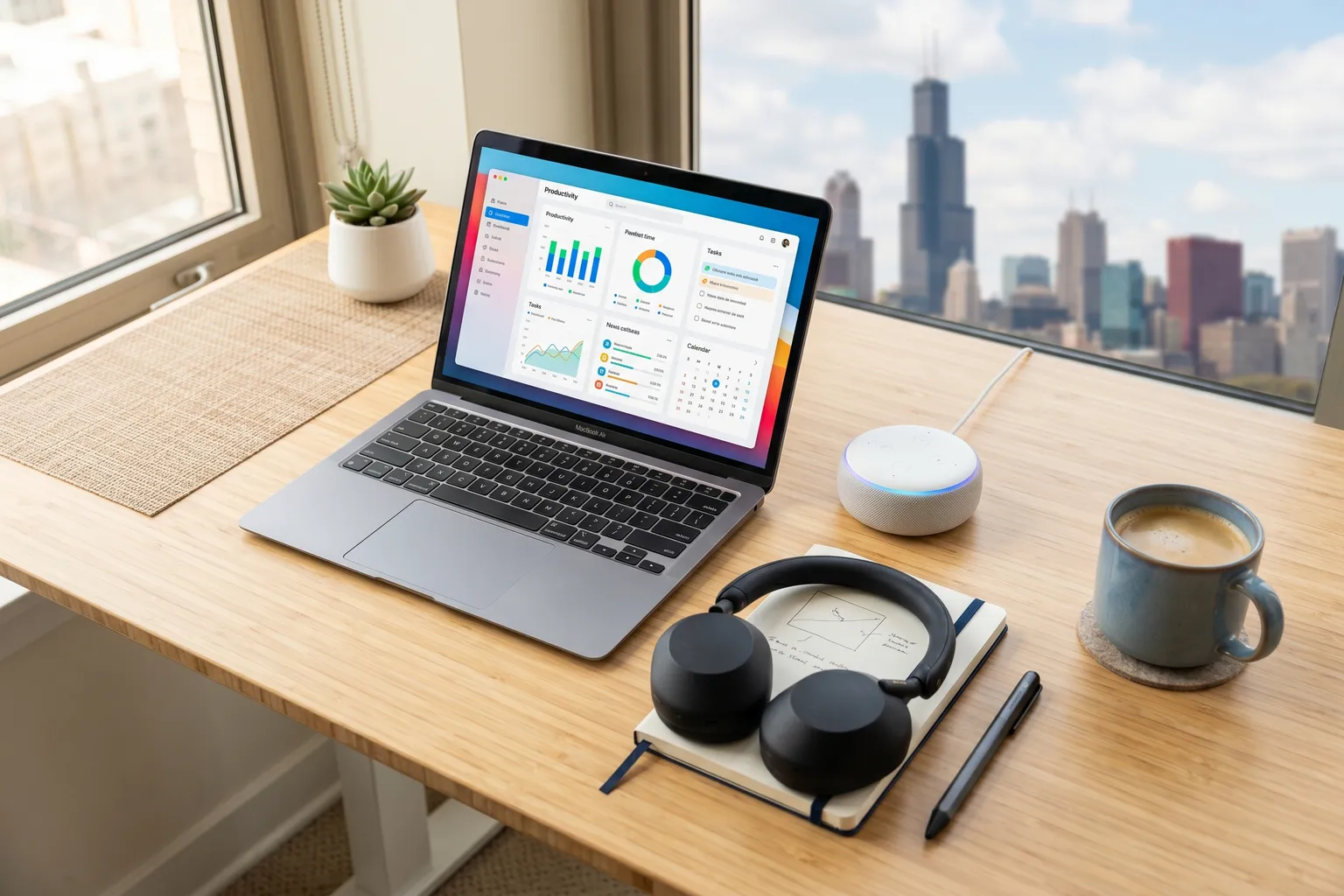
- Lindy is the best AI personal assistant overall — it goes beyond chatting and actually automates multi-step workflows across your apps, from inbox triage to CRM updates to meeting scheduling.
- Otter.ai is still the most reliable meeting notetaker if you're on a mixed-platform team — Zoom one call, Google Meet the next, Teams after that. It handles all three without drama.
- Reclaim.ai is the scheduling assistant I'd recommend first for Google Calendar users — it defends your focus time aggressively and reschedules around disruptions automatically.
- Motion is right for people who want AI to manage both their calendar and their task list as one unified system, not two separate tools.
- Clara handles scheduling back-and-forth over email better than any automation script I've seen — worth it if that's where your time bleeds.
- Perplexity AI is the research assistant you didn't know you needed — web-cited answers that cite their sources, with none of the hallucination risk you get from a plain chatbot.
- Claude is the general-purpose workhorse for long-form analysis, document review, and complex thinking tasks — the one I'd put on every knowledge worker's radar.
TL;DR: Lindy is the best AI personal assistant in 2026 for anyone who wants real automation — not just a smarter chat interface, but actual multi-step workflows that move work through your apps without you touching it. Otter.ai wins for meeting transcription across mixed platforms. Reclaim.ai and Motion handle scheduling, with Motion going deeper into task management. Perplexity AI is the research assistant that actually cites its sources. Claude is the general-purpose workhorse for writing and analysis. No single tool does everything — but this roundup tells you which one to start with.
The phrase “AI personal assistant” has been stretched so far it’s almost meaningless.
Ask three people what it means and you’ll get three different answers. One thinks of Siri and Alexa. One thinks of Otter.ai joining their Zoom calls. One thinks of something like Lindy building automations across their whole stack. They’re all technically right, and that’s the problem.
I’ve spent the last several weeks using seven tools in this category — not in a sandbox, but in real work situations. Scheduling calls, taking meeting notes, researching competitors, triaging email, automating follow-up workflows. The honest answer is that the “best AI personal assistant” depends entirely on what you’re trying to do.
But there’s a clearer winner for people who want to actually automate work rather than just chat with it. Let me explain.
Quick Comparison: AI Personal Assistants in 2026
| Tool | Category | Key Feature | Starting Price | Best For |
|---|---|---|---|---|
| Lindy | Workflow automation | Multi-step AI agents with app integrations | Free / ~$49/mo | Automating tasks across Gmail, Slack, Calendar, CRM |
| Otter.ai | Meeting notetaker | Real-time transcription + AI summaries | Free / $16.99/mo | Mixed-platform meeting documentation |
| Reclaim.ai | Scheduling | Auto-schedule tasks + protect focus time | Free / $8/mo | Google Calendar users protecting deep work |
| Motion | Scheduling + tasks | Unified AI calendar + project management | $34/mo | Individuals who want one dashboard for everything |
| Clara | Email scheduling | Email-native meeting coordination | ~$99/mo | High-volume meeting coordinators |
| Perplexity AI | Research assistant | Web-cited AI answers | Free / $20/mo | Research, competitive intelligence, fast answers |
| Claude | General-purpose AI | Long-context analysis and writing | Free / $20/mo | Document analysis, writing, complex thinking |
1. Lindy — Best Overall AI Personal Assistant
The case for Lindy is simple: it’s the only tool in this roundup that actually automates work rather than just helping you do work.
That distinction matters more than it sounds. Most “AI assistants” are still interaction-based — you ask, they answer, you act. Useful, but it still requires you in the loop. Lindy builds AI agents called “Lindies” that operate on triggers: a new email arrives, a meeting ends, a form gets submitted, a Slack message mentions a specific keyword. The Lindy fires, does what you told it to do across multiple connected apps, and reports back.
The practical result is that whole categories of work can disappear from your to-do list entirely.
I set up a Lindy that does the following when I receive an email from someone I’ve never corresponded with before: it checks if they’re in my CRM, drafts a contextual response based on what they’re asking, flags it in a Slack channel for my review, and schedules a draft reply for 2 hours later unless I send something manually first. The whole chain runs in about 30 seconds. Before Lindy, that process took me 8-10 minutes per cold contact — and I was doing maybe 15 of those a week.
That’s two hours back.
What Lindy does well: The integrations library is extensive — Gmail, Google Calendar, Outlook, Slack, HubSpot, Salesforce, Notion, and a long list of others. You don’t need to write code to build Lindies; the interface is conversational and template-based. The template library is where most people should start — there are pre-built Lindies for meeting prep, follow-up email drafting, CRM updates, research digests, and more.
The AI quality is solid. When Lindy drafts something on my behalf, I rarely have to do more than a light edit before sending. That’s the bar — it saves time in practice, not just in the demo.
Where Lindy falls short: It’s not a notetaker. It doesn’t do calendar management the way Reclaim.ai does. It’s an automation layer, and if you don’t have repetitive multi-step workflows that cross multiple apps, you won’t get the same ROI. Someone who works entirely in a single tool doesn’t need Lindy — they need something more purpose-built.
The onboarding also has a learning curve. The first Lindy you build takes longer than you’d expect because you’re learning the logic model. By the third or fourth, it clicks.
Pricing: Free tier available with limited Lindy runs per month. Pro plan runs approximately $49/month. Business pricing scales with usage and team size. Try Lindy here.
One thing that makes Lindy even more useful: pairing it with smart home automation. The Amazon Echo Dot (5th Gen) (~$39) integrates with Lindy through Alexa routines, so you can trigger certain Lindies with voice commands — useful if you want to kick off a workflow while you’re still in motion. It’s not a core use case, but for anyone with smart home setup already in place, it’s a genuinely frictionless way to start an automation without touching a keyboard.
2. Otter.ai — Best Meeting Notetaker
Otter.ai isn’t new. It’s been around since 2016 and has been fighting for the AI meeting notetaker category ever since. In 2026, it’s still one of the strongest options for teams that move across multiple video platforms.
The core feature set: OtterPilot joins your meetings automatically (Zoom, Google Meet, Microsoft Teams), transcribes in real time, identifies speakers, and generates an AI summary within minutes of the meeting ending. The summary includes action items pulled from the conversation. The search function lets you grep your entire meeting history for specific phrases or topics.
That last part is underrated. When someone asks “didn’t we decide something about the Q3 budget in March?” — I can actually answer that in 20 seconds instead of asking them to resend the notes.
For in-person meetings: Otter.ai also works on mobile. You can record a room conversation and get a transcript, though speaker identification is fuzzier when you’re not on a video call with labeled participants. It handles background noise reasonably well, but if you’re in a loud coffee shop or an open plan office, audio quality starts to matter.
For meetings that matter, a pair of headphones with a good microphone makes a real difference in transcription accuracy — both for what you capture when recording in person and for your own voice quality on calls. The Sony WH-1000XM5 (~$248) is what I’ve been using for about a year. Excellent call quality, noise cancellation is among the best in class, and the built-in mic is clean enough that my transcripts from Zoom calls look noticeably cleaner than they did with my laptop mic. Worth the investment if you’re in calls all day.
What Otter.ai does well: Platform support is the main differentiator vs. competitors. Most enterprises don’t run on a single platform — Teams for some departments, Zoom for external calls, Google Meet for the hybrid-work folks. Otter handles all three without requiring you to configure anything separately. It just works.
The free tier (300 minutes/month) is generous enough to actually evaluate it.
Where Otter.ai falls short: The AI summaries are good but not magical. They capture the main points, miss nuance, and occasionally misattribute who said what. You still need to skim the transcript for anything critical. The mobile app is also less polished than the web experience.
Pricing: Free (300 min/month, 3 imported files). Pro at $16.99/month (1,200 minutes). Business at $30/user/month (6,000 minutes, shared workspace). Try Otter.ai here.
For a deeper look at the meeting assistant category, our full roundup of best AI meeting assistants in 2026 compares Fathom, Fireflies, tl;dv, and more.
3. Reclaim.ai — Best Scheduling Assistant for Google Calendar Users
If meetings are eating your focus time, Reclaim.ai is the most direct fix I’ve found.
The premise: you tell Reclaim what matters — focus blocks, specific recurring tasks, habits like exercise or deep work — and it auto-schedules them in your calendar, defends those blocks against meeting requests, and reschedules intelligently when things inevitably move.
The key feature for most people is task scheduling. You create a task, give it an estimated duration and deadline, and Reclaim finds the right window for it in your calendar based on your existing commitments and time preferences. When a meeting gets added that would conflict, Reclaim moves the task to the next available slot automatically. You don’t have to manually shuffle things around. The calendar stays realistic instead of becoming aspirational fiction.
I found the habits feature particularly useful. I had a standing “no meetings before 10am” rule that I enforced manually with about 50% success. Reclaim enforces it without me thinking about it.
Limitations: Reclaim.ai is almost exclusively built around Google Calendar. If your organization runs on Microsoft 365 / Outlook, you’re out of luck — there’s no Outlook native integration at a functional level. That’s a meaningful constraint for enterprise IT environments.
The free tier is surprisingly functional. I used it for several months before hitting the limits.
Pricing: Free (limited tasks/habits). Starter at $8/user/month. Business at $12/user/month. Enterprise custom. Try Reclaim.ai here.
4. Motion — Best for Unified Calendar + Task Management
Motion is what you get when someone rebuilds Reclaim.ai with project management baked in from the start.
Where Reclaim.ai’s primary interface is your calendar, Motion gives you a full task management view alongside it. Projects, tasks, subtasks, deadlines — all visible, all managed by the same AI that handles your calendar. The AI reschedules not just around meetings but around your entire task load, estimating time, prioritizing by deadline, and adjusting daily.
The result is that Motion is more comprehensive than Reclaim.ai but also more demanding. There’s more to set up. There’s more to maintain. If you’re disciplined about putting everything into Motion, it can genuinely function as your single planning interface. If you’re not, you end up with two partial systems.
The honest comparison: Reclaim.ai is better for people who want light-touch scheduling protection with minimal setup overhead. Motion is for people who want AI actively managing their whole day and are willing to put in the setup work.
Pricing: Individual at $34/month. Team at $20/user/month (annual). Slightly pricier than Reclaim.ai, but the feature depth justifies it for the right user. Try Motion here.
5. Clara — Best for Email-Based Scheduling Coordination
Clara is the most specialized tool in this roundup, and I almost didn’t include it because of the price.
But I kept coming back to one use case: if scheduling meetings via email is where your time bleeds, nothing else I tested handles it as elegantly.
The mechanic: you CC [email protected] on an email, and Clara takes over the scheduling thread. She replies to your contact as “Clara, Ray’s assistant,” proposes times based on your calendar availability, handles the back-and-forth when they counter-propose, and creates the calendar event once confirmed. She writes like a human assistant. I’ve had multiple people ask if Clara was a real person.
For executives and anyone who coordinates dozens of external meetings per month, that’s real time savings. The email-native flow means there’s no scheduling link for contacts to feel weird about.
Limitations: The price (~$99/month for the professional tier) is steep for individual contributors. Clara is purpose-built for people with high meeting volumes — founders, executives, recruiters, sales leaders. If you’re scheduling five external meetings a week, Calendly is probably good enough. Clara is for people scheduling fifteen-plus.
Pricing: Check claralabs.com for current plans — pricing has shifted over the years. Budget approximately $99/month for individual professional use.
6. Perplexity AI — Best Research Assistant
Look, I was skeptical of Perplexity for a long time. Another AI chatbot, basically.
Wrong.
The difference is how it handles knowledge. A standard chatbot answers from its training data and occasionally hallucinates with complete confidence. Perplexity searches the web in real time for every query and cites its sources inline. You get an answer AND a bibliography. You can click through to verify any claim. The information is current, not frozen at a training cutoff.
For research tasks — competitive analysis, background checking a company before a sales call, quickly understanding an unfamiliar regulatory requirement, finding the current pricing for a software tool — it’s dramatically faster than opening eight browser tabs. And it’s more reliable than asking a chatbot that might plausibly make something up.
The research workflow I’ve settled into: Perplexity for any question where recency or verifiability matters. Claude (below) for analysis, synthesis, and writing tasks where I’m working with documents I’ve already gathered.
Pro features: The $20/month Pro plan gives you access to more capable underlying models (GPT-4o, Claude, and others via model picker) and higher daily query limits. Worth it if you’re using it heavily. The free tier is functional but rate-limited.
For anyone doing intensive research alongside Perplexity, a Rocketbook Core Reusable Smart Notebook (~$32) is worth keeping on your desk. I know — low tech next to an AI research tool. But there’s real value in being able to sketch connections between ideas by hand, then scan the page into Notion or your workflow tool via the Rocketbook app. Perplexity gives you the research; the notebook is where you think through what it means.
Read our full Perplexity AI review if you want a deeper breakdown of Pro vs. free.
Pricing: Free (daily query limits). Pro at $20/month (higher limits, model picker, Pro Search). Try Perplexity here.
7. Claude — Best General-Purpose AI Workhorse
Full disclosure: this site was partially built with Claude. I’ve been using it daily for about 18 months. So take this section with that context in mind — I’m not neutral, and I’m also not going to pretend it’s not the tool I reach for most.
Claude isn’t a meeting notetaker. It doesn’t manage your calendar. It doesn’t automate workflows. What it does better than almost anything else: think through complex problems with you, work with long documents, write and edit with a consistent voice, and stay coherent across a very long conversation.
The long context window is the underrated feature. I’ve pasted full contract drafts, 40-page analyst reports, and entire email threads into Claude and gotten genuinely useful analysis. Not summary — analysis. “What are the three biggest risks in this contract that aren’t in the summary section?” That kind of question.
For knowledge work, the real use cases are: document review, first drafts of anything substantive, research synthesis once you’ve gathered sources, and strategic thinking when you want a thinking partner who won’t get bored.
Limitations: Claude doesn’t have real-time internet access by default (though Claude with web search is available in some contexts). For current information, Perplexity is the better tool. And unlike Lindy or Reclaim.ai, Claude doesn’t connect to your calendar, email, or other apps natively — you bring the information to it, rather than it pulling from your stack.
No affiliate program active for Anthropic. I’m including Claude because it belongs in this roundup. If you haven’t tried it, claude.ai has a functional free tier.
Read our full Claude AI review for the detailed breakdown.
Pricing: Free tier (rate-limited). Claude Pro at $20/month (higher limits, priority access). Try Claude here.
How to Choose: Matching the Tool to the Problem
The honest answer is that most productive people end up using two or three of these in combination. That’s not a cop-out — they solve different problems.
If you want automation across apps: Start with Lindy. It’s the highest-leverage tool in this list for people with repetitive cross-app workflows.
If you’re in meetings constantly: Otter.ai for transcription and AI summaries. Nothing else handles mixed-platform teams as reliably.
If your calendar is chaos: Reclaim.ai for Google Calendar users. Motion if you want task management folded in.
If you’re scheduling external meetings all day: Clara. Expensive but it pays for itself fast at high meeting volume.
If you need fast, verifiable research: Perplexity AI. Especially for anything where the information might have changed in the last 12 months.
If you’re doing writing and complex thinking: Claude. Not for real-time data, but the best long-context reasoning available.
The tools complement each other more than they compete. Lindy can take action on things Otter.ai surfaces. Perplexity can feed research into Claude. Reclaim.ai and Motion protect the time you need to actually use the other tools.
The broader category is maturing fast. A year ago, most “AI assistant” tools were sophisticated scheduling apps or decent transcribers. Now the automation layer has arrived — tools like Lindy that don’t just assist but act. That shift is worth paying attention to.
Pick the problem that costs you the most time. Start there.
Also see: Best AI Meeting Assistants in 2026 | Best AI Inbox Management Tools 2026 | Best AI Chatbots 2026