
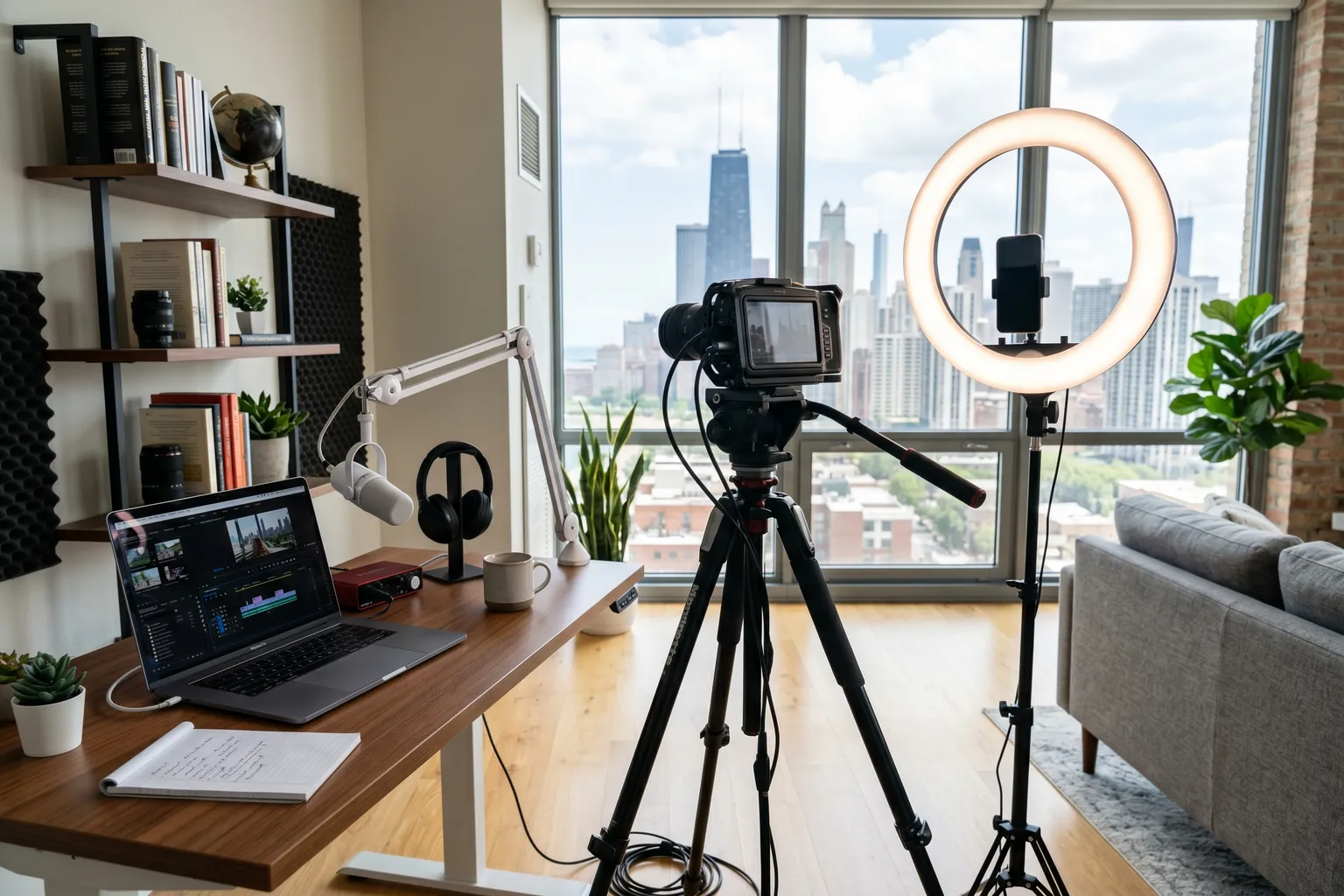
- The Canon EOS R50 is the best YouTube camera for most new creators — affordable, idiot-proof autofocus, good video quality, and room to grow within Canon's lens ecosystem
- The Sony ZV-E10 II has the best autofocus in the APS-C vlogging category — if tracking your face through a busy frame matters, nothing touches it under $1,000
- The Fujifilm X-S20 is the pick for creators who want a distinctive visual style without spending hours in post — Fujifilm's film simulations are as close to built-in color grading as exists
- The DJI Pocket 3 is the most underrated YouTube camera available — incredibly stable footage in a device smaller than your phone, and the gimbal beats buying a camera plus stabilizer separately
- For most YouTube channels under 100K subscribers, the phone in your pocket already outperforms what most viewers can detect — upgrade your audio before you upgrade your camera
Most camera recommendations for YouTubers are wrong.
Not technically wrong. Wrong in the way that matters: they recommend what impresses photographers, not what helps a creator make consistent, good-looking videos without hating the process. There’s a gear-head reflex in camera coverage that defaults to “more is better” — more megapixels, bigger sensor, more video codecs. For YouTube, that logic breaks down fast.
A $2,500 camera you’re afraid to bring out in rain is worse than a $400 camera you take everywhere. An interface with three menu layers between you and adjusting exposure will make you stop adjusting exposure. A camera that gets uncomfortably warm during a 30-minute recording session is not a YouTube camera.
I’ve approached this list the same way I approach enterprise software: does the tool help you get the job done without getting in your way? For YouTube, the job is making videos people watch. The camera is one component of that – not the most important one.
For a deeper look at mirrorless options beyond YouTube-specific use, the best mirrorless cameras of 2026 covers the full field. If you’re also thinking about using AI tools to streamline production, the guide to creating marketing videos with AI is worth a read alongside this.
Quick Comparison: Best YouTube Cameras 2026
| Camera | Sensor | Resolution | Price | Best For |
|---|---|---|---|---|
| Sony ZV-E10 II | APS-C | 26MP | ~$750 | Solo vloggers, APS-C AF quality |
| Canon EOS R50 | APS-C | 24MP | ~$600 | Beginners, versatile creators |
| Fujifilm X-S20 | APS-C | 26MP | ~$1,300 | Film look, long recording sessions |
| Sony ZV-1 II | 1-inch | 20.1MP | ~$750 | Compact point-and-shoot vlogging |
| GoPro HERO12 Black | 1/1.9-inch | 27MP | ~$350 | Action, outdoor, adventure channels |
| DJI Pocket 3 | 1-inch | 20MP | ~$345 | Stable handheld footage, travel |
| Sony A7C II | Full-Frame | 33MP | ~$2,200 | Best quality regardless of cost |
| iPhone 16 Pro / Pixel 9 Pro | Phone sensor | varies | (phone you own) | Accessibility, low friction |
1. Sony ZV-E10 II — Best APS-C Camera for YouTubers
Price: ~$750 body | Check on Amazon
The ZV-E10 II is what happens when Sony actually listens to what vloggers complain about. The original ZV-E10 was good but the autofocus frustrated people. Sony fixed it. The Mark II gets Real-time Recognition AF – the same system in their higher-end mirrorless bodies – and it tracks faces and eyes through frame with an accuracy that makes you forget you’re worried about it.
That matters for solo creators more than almost any other spec. When you’re behind the camera and in front of it, you can’t babysit focus. The ZV-E10 II just handles it.
The fully articulating screen flips out and forward, which sounds trivial and is not. This is the primary UI for solo vlogging – you need to see yourself while you’re recording. Canon has had this right for years. Sony finally caught up properly.
Product showcase mode is a feature I initially dismissed as gimmicky. It switches focus priority between your face and whatever you’re holding toward the camera – useful for unboxing channels, review content, cooking videos where you’re constantly moving between yourself and what you’re demonstrating. It works, and creators who need it genuinely use it.
What you’re not getting: No IBIS. Sony’s digital stabilization is fine for stationary and tripod shooting, introduces a bit of crop for walking handheld. If you’re doing walking vlogs without a gimbal, the footage will show it. And the battery – bring a second one. Always.
For talking-head content, tutorials, product reviews, desk setups – the ZV-E10 II is the strongest APS-C YouTube camera available at this price point. The autofocus is the differentiator.
2. Canon EOS R50 — Best Entry-Level YouTube Camera
Price: ~$600 body | Check on Amazon
My recommendation for most people who ask me “what camera should I buy for YouTube?”
The R50 does everything a new creator needs without creating obstacles. The menus are logical. The autofocus – Dual Pixel CMOS AF II – tracks faces and eyes accurately enough that you won’t miss shots because of it. The 24MP APS-C sensor produces clean 4K video and excellent stills. The flip-out touchscreen works properly for self-monitoring. There’s a mic input.
Canon paired this with their RF-S lens mount, which means you’re buying into Canon’s current and future lens lineup. That’s the right ecosystem to be in. A $600 body with a Sigma 16mm f/1.4 EF-M or an RF 35mm f/1.8 IS is a setup that outperforms rigs costing three times as much on most YouTube formats.
The honest caveats: no IBIS (important if you shoot handheld video without a tripod), no headphone jack for audio monitoring, and the 4K mode applies a slight crop. The crop can be worked around – use a slightly wider lens. The no-IBIS situation is a real limitation for walking-and-talking content unless you’re pairing it with a gimbal.
For desk setups, interviews, tutorials, beauty content, product reviews, and anything where the camera is on a tripod or small stand – the R50 is completely capable. Most YouTube channels fall into that category.
I’ll say it directly: a Canon R50 with a decent prime lens and a good USB microphone – that kit at around $800 total – will produce better YouTube content than most of what you’re watching right now. The gear isn’t the variable most people think it is.
3. Fujifilm X-S20 — Best for Creators Who Want a Distinctive Look
Price: ~$1,300 body | Check on Amazon
The X-S20 occupies a specific position in the YouTube camera market: it’s for creators who’ve realized that color grading is eating into their production time, and want a camera that handles it in-body.
Fujifilm’s film simulations – Classic Chrome, Velvia, Eterna Cinema, the various film stock modes – are built into the video pipeline. You’re not applying a filter after the fact. You’re shooting in the simulation and getting footage that has a character most cameras can’t replicate in post without significant work. Eterna Cinema in particular is a look that’s identifiable on YouTube once you’ve seen it. Creators who use it tend to stand out.
The X-S20 also has the best battery life in any APS-C mirrorless at this price. 810 shots per charge – roughly double what Sony offers. For creators who record long sessions, travel without access to charging, or want to minimize the between-takes fumbling with dead batteries, this is a meaningful advantage.
6.2K open gate video. 4K 30fps without crop. 1080p 240fps for smooth slow motion. IBIS that works well enough for handheld use. The video specs are genuinely impressive for the price.
The autofocus isn’t at ZV-E10 II levels for face tracking in challenging conditions. For most YouTube formats – controlled indoor setups, interviews, travel content where you’re not sprinting – it’s more than sufficient. If you’re doing high-energy vlogging with constant motion and complex backgrounds, the Sony’s AF is more reliable.
For the creator who’s past the beginner phase, wants to build a distinctive visual style, and is tired of color grading every clip individually – the X-S20 is the best tool I know of for that problem.
4. Sony ZV-1 II — Best Compact Point-and-Shoot for YouTube
Price: ~$750 | Check on Amazon
The ZV-1 II is a fixed-lens camera – 18-50mm equivalent zoom, which is actually a surprisingly useful range for vlogging – on a one-inch sensor. The trade you’re making versus an interchangeable-lens body: smaller size, pocket-able, no lens decisions to make, ever. The advantage of that trade is underestimated.
There’s a category of YouTube creator for whom the ZV-1 II is genuinely the right camera: people who travel a lot, want to shoot spontaneous moments, and don’t want to think about lenses or carry extra gear. The ZV-1 II goes in a jacket pocket. The ZV-E10 II doesn’t.
The one-inch sensor is smaller than APS-C but significantly larger than most smartphone sensors. Image quality in decent light is excellent. Sony’s autofocus is strong even in this smaller body. The directional three-capsule microphone picks up the creator while minimizing ambient noise from the sides. In a small café, on the street, at an event – it does something most cameras can’t match in that footprint.
The limitation is obvious: at high ISOs, a one-inch sensor trails APS-C bodies noticeably. Night shooting and dim indoor situations expose the gap. If you’re shooting mostly outdoors or in well-lit interiors, you won’t run into it. If you shoot in challenging light, you’ll want one of the APS-C cameras above.
5. GoPro HERO12 Black — Best Action Camera for YouTube
Price: ~$350 | Check on Amazon
The HERO12 is not a general-purpose YouTube camera. It’s the right camera for a specific genre: action content, outdoor adventure, sports, anything where a conventional camera would get destroyed or produce unusable footage.
Waterproof without a case. Shockproof. Can be mounted to a helmet, handlebars, surfboard, chest harness. The HyperSmooth 6.0 stabilization turns chaotic handheld footage into something watchable. If you’re running, cycling, skiing, surfing, doing anything that moves fast – the HERO12 produces footage that a traditional camera can’t replicate.
5.3K video at 60fps. 27MP photos. The Max Lens Mod 2.0 opens up a truly wide field of view that captures spatial context traditional lenses can’t.
For channels that mix action and talking-head content: keep a dedicated camera for interviews and desk setups, use the HERO12 for the action sequences. That two-camera approach is what most outdoor and adventure channels actually do.
The limitation for YouTube specifically: there’s no external microphone input on the standard body (only with Creator Edition accessories). The built-in mics are good by action camera standards, but wind noise is a real issue outdoors. If audio quality matters – and it does – factor in a GoPro-compatible external mic or the Media Mod.
6. DJI Pocket 3 — Best Gimbal Camera for YouTube
Price: ~$345 (standard) | Check on Amazon
The DJI Pocket 3 is consistently underrated in YouTube camera roundups, and I’m not sure why. It’s one of the most practical content creation tools available.
The Pocket 3 is a camera on a three-axis gimbal, about the size of a large smartphone. The gimbal is built-in – not a separate rig you mount a camera to. That means you get mechanically stabilized footage as the default, not an afterthought. Walk around with it, hold it at arm’s length, pivot it dramatically – the footage is smooth in a way that digital stabilization in a traditional camera can’t fully match.
The 1-inch CMOS sensor is the same form factor as the Sony ZV-1 II. Image quality is very good in decent light. The 4K/120fps high-frame-rate mode opens up genuine cinematic slow motion. The rotating 2-inch touchscreen handles framing from multiple angles including portrait for vertical-first social content.
The ActiveTrack face-tracking works well for solo creators – the camera follows your face as you move, which removes the need for a static tripod in many scenarios.
Where it falls short: a one-inch sensor has limits, especially indoors at night. There’s no interchangeable lens – what you get is a fixed focal length. And the microphone performance, while good for the form factor, trails what a proper camera-plus-external-mic setup delivers.
For travel vlogs, walking content, lifestyle channels, and anyone who values “I’ll actually carry it everywhere” over maximum spec – the Pocket 3 is the camera I’d pick. The combination of sensor quality, stabilization, and portability at ~$345 is a genuinely strong value proposition.
7. Sony A7C II — Best YouTube Camera If Quality Is the Priority
Price: ~$2,200 body | Check on Amazon
The A7C II is the camera at the top of the practical YouTube camera pyramid. Full-frame 33MP sensor. Best autofocus tracking in the business. 4K at 60fps in 10-bit S-Log3 if you want it. IBIS that works. A body that’s smaller than most APS-C cameras.
For creators making cinematic travel content, documentary-style videos, or anything where image quality is the differentiator – the A7C II delivers something the cameras below it can’t fully replicate. The full-frame sensor in challenging light produces footage that’s cleanly a level above APS-C. If you’re shooting in dim environments regularly, that gap is real.
But – and this is important – most YouTube channels will never fully use what the A7C II offers. The audience can’t tell the difference between A7C II footage and R50 footage if both are properly exposed and color-corrected. They can tell the difference between good audio and bad audio in the first five seconds.
The A7C II is the right call when: you’re making a living from your channel, production quality is genuinely your competitive advantage, you’re also doing commercial photography or video work with the same body, or you simply want the best and the budget isn’t the constraint. No judgment on any of those reasons.
For everything else, one of the cameras above will serve you better per dollar.
8. iPhone 16 Pro or Pixel 9 Pro — The Camera You Already Own
No Amazon link here. Because you might already have this camera.
This is the recommendation that gear-head roundups skip, and it’s irresponsible to skip it. The iPhone 16 Pro shoots 4K at 120fps in ProRes. The Pixel 9 Pro’s video looks excellent in good light. Both have real optical stabilization. Both have usable built-in audio. Both go everywhere because they’re already in your pocket.
For a channel that’s just starting out – especially if the goal is to build an audience before investing heavily in gear – the phone is the right call. The friction of a dedicated camera setup is underestimated. If having to set up a camera adds 10 minutes to a production and causes you to skip shoots you would have done spontaneously, the camera is actively hurting your output.
Make videos first. Prove consistency. Then invest in dedicated gear.
A Canon R50 with a Sigma 16mm f/1.4 at around $800 total is a legitimate upgrade that justifies itself once you’re making content regularly. Before that point – the phone is not a compromise. It’s the practical choice.
The Actual Decision
Here’s how I’d actually narrow this:
Just starting, want something dedicated under $700: Canon R50. Buy a decent prime lens. Use a USB mic.
Starting out but value portability above all: DJI Pocket 3. It’s ~$345, goes everywhere, and produces stabilized footage that’ll make you look more competent than you are.
Action/outdoor channel: GoPro HERO12 Black. Nothing else makes sense in that specific context.
APS-C + best autofocus for solo vlogging: Sony ZV-E10 II. The tracking is the differentiator.
Want distinctive color without color grading, long recording sessions: Fujifilm X-S20. The film simulations are that good.
Prioritizing compactness over lens flexibility: Sony ZV-1 II.
Production quality is genuinely your advantage: Sony A7C II. Accept the price.
Not sure you’ll stick with it: Use the phone you have. Come back when you’ve published twenty videos and you’re still doing it.
The single biggest upgrade for 95% of YouTube setups isn’t a new camera. It’s a better microphone, better lighting, or just more consistent publishing. Get the camera right enough – then spend your energy on the content.
If you want a broader look at the mirrorless options that might suit both YouTube and general photography, the best mirrorless cameras guide covers cameras beyond the vlogging-specific focus here. And if you’re exploring AI tools to speed up video production, the AI video guide is worth a look.