
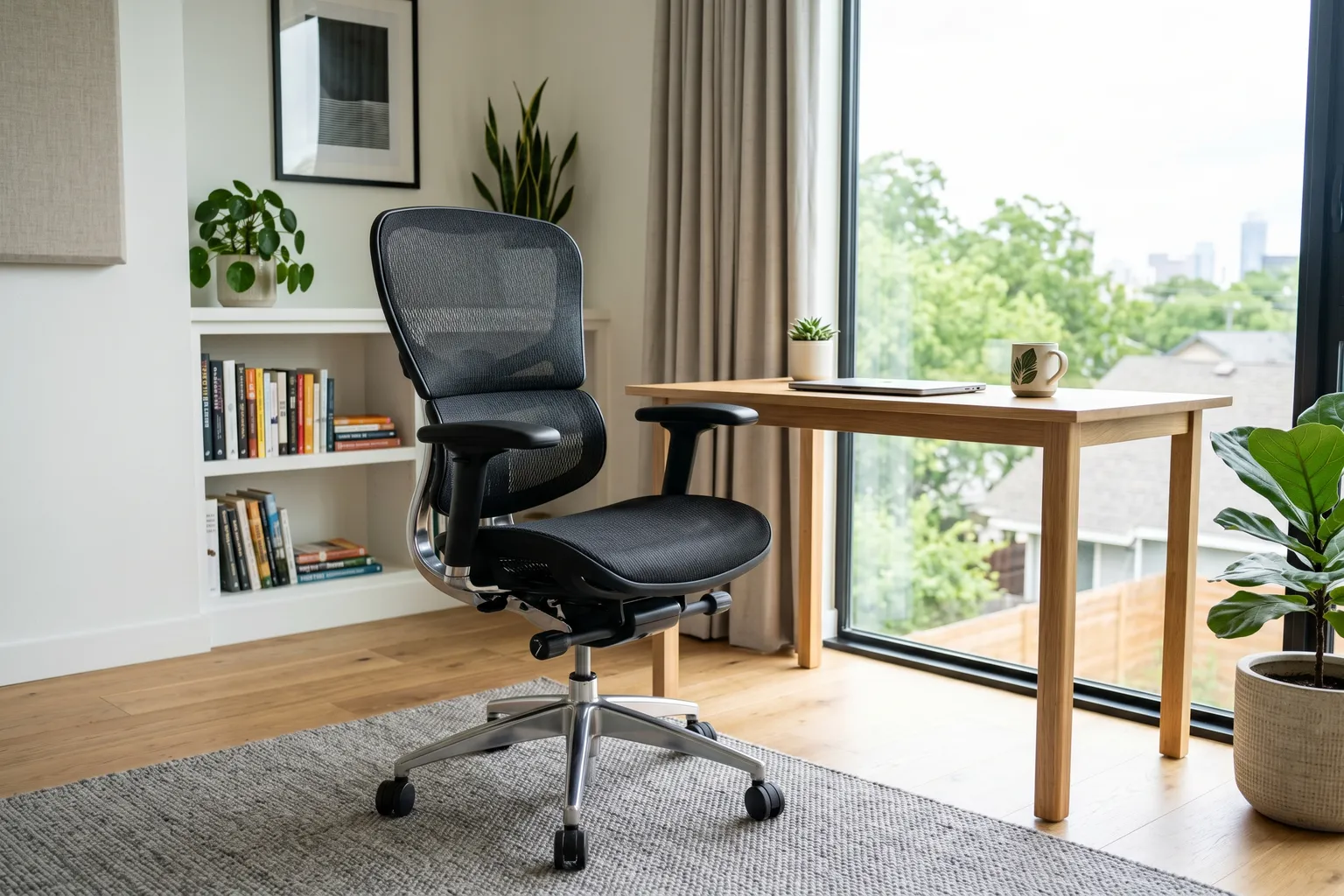
- Herman Miller Aeron is the gold standard but $1,400+ new — the refurbished market is your friend if you want the real thing.
- Secretlab TITAN Evo expands into office chairs and it's genuinely good — especially if you also game.
- Branch Ergonomic Chair at $499 is the best value in the sub-$500 segment, full stop.
- Don't buy any chair without a lumbar adjustment. Fixed lumbar support fits some bodies and not others — you want the option.
- Mesh backs breathe better in warm offices; foam/upholstered backs feel better initially but trap heat over long sessions.
Your back already knows if you’ve been sitting on the wrong chair. It’s been telling you for months.
I’ve spent a lot of time in the ergonomic chair market — partly from professional necessity, partly because I have the kind of L4-L5 disc situation that makes a bad chair feel like a punishment within two hours. I’ve tested chairs the way I test everything: by looking for where they fail, not where they shine. Anyone can describe a chair’s good points. The useful information is what breaks down, what feels good in week one and terrible in month six, and which features are real versus marketing theater.
This list covers eight chairs worth considering in 2026, from the unambiguous best-money-can-buy options down to a budget pick that I genuinely find hard to argue against.
One thing before we get into it: pair a good chair with a good monitor position, and you’ve solved about 80% of home office ergonomics. A monitor arm lets you dial in screen height independently of your desk — that matters more than people think.
Quick Comparison Table
| Chair | Price (approx.) | Lumbar | Seat Depth Adj. | Armrests | Warranty | Best For |
|---|---|---|---|---|---|---|
| Herman Miller Aeron (refurb) | ~$700–900 | PostureFit SL | No | 4D | 12 years (certified refurb) | Best overall |
| Steelcase Leap V2 (refurb) | ~$600–850 | LiveBack | Yes | 4D | 12 years (certified refurb) | Long sessions |
| Secretlab TITAN Evo | ~$549 | 4-way adjustable | Yes | 4D | 3 years | Gaming/office crossover |
| Branch Ergonomic Chair | ~$499 | Adjustable | Yes | 4D | 5 years | Best under $500 |
| HON Ignition 2.0 | ~$300–400 | Fixed | Yes | 4D | Lifetime | Budget commercial |
| Autonomous ErgoChair Pro | ~$499 | Adjustable | Yes | 4D | 2 years | Direct-to-consumer |
| SIHOO Doro C300 | ~$400 | Dynamic | Yes | 4D | 2 years | Budget mesh |
| Amazon Basics High-Back | ~$100–130 | Fixed | No | Fixed | 1 year | Absolute budget only |
1. Herman Miller Aeron (Refurbished) — Best Chair You Can Actually Justify
Herman Miller Aeron (Refurbished) — ~$700–900 certified refurbished
The Aeron is the answer to “what’s actually the best ergonomic chair?” It’s been the answer since 1994 and it’s still the answer in 2026. Not because Herman Miller has great marketing — they do, but that’s not the point — but because the chair has held up under real-world use by millions of office workers for three decades. That’s not luck.
New, you’re looking at $1,400 to $1,900 depending on size and configuration. That’s hard to stomach. The certified refurbished market changes the math dramatically. You can find fully refurbished Aerons in the $700–900 range from reputable sellers, often with warranties that cover the mechanical parts. Herman Miller themselves run a certified refurb program. The chair was built for commercial use — it was designed to be serviced and to last.
The Aeron’s 8Z Pellicle mesh is the part nobody talks about enough. It’s not just “breathable mesh” in the marketing-speak sense — it’s a suspension system that distributes weight across the mesh rather than concentrating it at pressure points. Sit on it for eight hours in a warm room and come back to this paragraph. You’ll know what I mean.
What actually makes it ergonomic: the PostureFit SL supports both the sacrum and the lumbar simultaneously, which is different from chairs that prop just the lumbar curve. The armrests are four-dimensional — height, width, pivot, and forward/back — which sounds like overkill until you’ve tried to type with armrests that don’t quite fit your body. The tilt mechanism has been refined for decades. Everything that moves on the Aeron moves for a reason.
Sizing matters. The Aeron comes in A (small), B (medium), and C (large). Most adults are B. If you’re under 5'4" or over 6'2", check the size guide carefully. Buying the wrong size negates most of the ergonomic benefit.
The one genuine knock: no seat depth adjustment on most configurations. That’s a real limitation for people whose thighs don’t fit the standard seat depth. If that’s you, the Steelcase Leap V2 below solves it.
2. Steelcase Leap V2 (Refurbished) — Better for Long Sessions
Steelcase Leap V2 (Refurbished) — ~$600–850 certified refurbished
The debate between the Aeron and the Leap has been going on in office chair forums since the early 2000s. I’m not going to settle it here — both are excellent and the right choice depends on your body.
What the Leap does differently: the LiveBack system flexes and moves with your spine rather than holding a fixed position. The idea is that your back wants to move even when you’re sitting still — subtle postural shifts that static support systems fight against. Whether you feel this or not depends on how sensitive you are to it.
The seat depth adjustment is real and it matters. You can slide the seat pan forward and back by about 4 inches, which lets people of very different thigh lengths get proper support. The Aeron doesn’t have this. If you’re on the shorter or taller end of the range and have found chairs consistently uncomfortable at the knee, this is worth trying.
Build quality is comparable to Herman Miller — both companies make commercial furniture that gets used in offices for 15 years with minimal maintenance. The Leap V2 has been in production since 2006 with incremental refinements. Buying refurbished is sensible: these chairs are built to be serviced, and a properly refurbished Leap V2 should have many years of life left.
Slightly heavier and more substantial-feeling than the Aeron. Some people like this; some find the Aeron’s lighter feel more comfortable. If you can try both in person — at an office furniture showroom or a refurbisher who allows trials — do it. This is one of those cases where personal preference is legitimate and not just rationalization.
3. Secretlab TITAN Evo — For People Who Game and Work
Secretlab TITAN Evo — ~$549
I’ll be honest: I went into this one skeptical. Gaming chairs have an earned reputation for prioritizing aesthetics over function. The racing-seat bolsters look great; they also prevent you from sitting with your hips properly positioned. Most gaming chairs are just wrong for an eight-hour workday.
The TITAN Evo is different enough from the category to be worth separating out.
Secretlab built an actual lumbar system — four-way adjustable, with meaningful range — rather than the decorative lumbar pillows that ship with most gaming chairs. The seat depth adjusts. The armrests are 4D. The tilt mechanism has a functional range rather than just reclining until you’re looking at the ceiling. They used cold-cure foam that holds its shape rather than the cheap foam that compresses into a pancake over six months.
Where it still shows gaming-chair DNA: the side bolsters are still present, though less aggressive than most of the category. The aesthetic leans sporty. It comes in color options that no respectable commercial chair would offer. If you care about looking professional on video calls, this might not be it.
But if you use your desk for both work and gaming, and you’re not willing to swap chairs between sessions, the TITAN Evo is genuinely the best crossover option on the market right now. Nothing else in the gaming chair space comes close to it ergonomically.
Weight capacity up to 290 lbs. Available in Regular and XL sizing.
4. Branch Ergonomic Chair — Best Under $500
Branch Ergonomic Chair — ~$499 (branchfurniture.com)
Branch doesn’t sell on Amazon, which is actually part of how they keep the price where it is. Cut out the 15–20% Amazon take, pass some of it to the customer. The chair is available directly from Branch’s website.
At $499, it’s competing with chairs that offer a fraction of its adjustability. You get seat depth adjustment, 4D armrests, adjustable lumbar support, adjustable headrest, and a decent tilt tension system. That’s a feature list that would’ve cost you $800+ five years ago.
The build quality is good — not Steelcase or Herman Miller good, but meaningfully better than the HON and SIHOO options lower on this list. The mesh back breathes well. The lumbar system has enough range to actually accommodate different body types rather than just providing one fixed position and calling it a day.
The five-year warranty is solid for this price tier. Branch also has a 30-day return policy, which matters — you can’t really evaluate a chair in a showroom, and 30 days of actual desk use tells you everything.
My actual complaint: the seat cushion is slightly firmer than I’d prefer straight out of the box. Breaks in reasonably, but the first few weeks feel stiff compared to higher-end options. Not a dealbreaker at this price.
If you can’t or won’t spend Herman Miller money, start here. Don’t buy three $150 chairs trying to avoid spending $499 — I’ve seen that movie and it ends with you spending $499 anyway, plus $450 in regret.
5. HON Ignition 2.0 — Best Commercial Budget Option
HON Ignition 2.0 — ~$300–400
HON is a commercial furniture company that sells office chairs to actual businesses — the kind that put 20 of them in a call center and need them to survive for a decade. That’s a different design brief than “looks impressive on Amazon product photos.”
The Ignition 2.0 reflects that. The build quality is serious for the price. The mechanism is durable. The lifetime warranty on the frame is real (HON honors it — I’ve seen it documented multiple times in user communities). At $300–400, you’re getting something that’ll last considerably longer than most alternatives at this price.
The tradeoffs: the lumbar support is fixed, not adjustable. That’s a genuine problem for some bodies and a non-issue for others. If the fixed position happens to hit your lumbar curve correctly, you’ll be happy. If it doesn’t, you’ll feel it within the first week. No seat depth adjustment either.
For people who know their body fits the fixed lumbar position — or who’ve sat in HON chairs at an office before — this is a strong buy. For everyone else, the slightly higher price of the Branch Ergonomic Chair is worth it for the adjustability.
The armrests are 4D, which is better than most chairs in this price range. Good height range on the seat. This is an honest commercial chair at a consumer price.
6. Autonomous ErgoChair Pro — Direct-to-Consumer Mid-Range
Autonomous ErgoChair Pro — ~$499 (autonomous.ai)
Autonomous has been in the direct-to-consumer ergonomic furniture space for a while, and the ErgoChair Pro is their flagship seating offering. Like Branch, they sell direct rather than through Amazon, which allows for a more aggressive price point.
The feature list is impressive on paper: adjustable lumbar, adjustable headrest, 4D armrests, recline with adjustable tension. The flexible back design is supposed to move with your spine.
In practice, the quality control is less consistent than the Branch Ergonomic Chair. User reviews across multiple platforms show a wider variance in experience — some people are extremely happy, some report quality issues that shouldn’t exist at this price point. The 2-year warranty is shorter than Branch’s 5 years, which tells you something about each company’s confidence in their product.
I’d put this as a solid second choice in the $499 price tier. If Branch is out of stock or you’ve found a discount on the Autonomous, it’s worth considering. But the Branch has a more consistent track record and better warranty coverage, which tips my recommendation.
The chair does look better than most in its category — clean, professional aesthetic that won’t embarrass you on video calls.
7. SIHOO Doro C300 — Budget Mesh with Actual Ergonomics
SIHOO Doro C300 — ~$350–420
SIHOO is a Chinese ergonomic furniture brand that’s been expanding its North American presence over the last few years. The Doro C300 is their flagship model and it does something interesting: the lumbar support is described as “self-adapting” — it’s designed to flex and follow your movement rather than holding a fixed position.
In practice, this works reasonably well. The chair is more adaptable than its price would suggest. Mesh back, adjustable seat depth, 4D armrests — the feature set is competitive.
What holds it back relative to the Branch and Autonomous options: the build quality shows its price. The materials are fine but not premium. The long-term durability is harder to assess because the brand hasn’t been in the Western market long enough to have ten-year reliability data. The two-year warranty is thin.
For someone on a tighter budget who needs actual ergonomic adjustability and can’t stretch to $499, the Doro C300 is the best option I can find in the $350–420 range. It beats the HON Ignition 2.0 on adjustability, though the HON has better long-term durability data behind it.
8. Amazon Basics High-Back Executive Chair — Fine If That’s Your Number
Amazon Basics High-Back Executive Chair — ~$100–130
I’ll be brief because this chair doesn’t need much analysis.
It’s a $100 office chair. The foam will compress within 6–12 months. The lumbar support is fixed and generic — it fits some backs and not others. There’s no seat depth adjustment. The armrests don’t adjust. The one-year warranty signals exactly how long Amazon expects it to last.
It’s not bad for what it is. “What it is” is a temporary solution. If you need a chair for an occasional-use guest desk, or you’re outfitting a room that gets used one day a week, or you genuinely can’t spend more than $130 right now, this isn’t the worst option at its price.
But if you sit in this chair for eight hours a day because you thought you were saving money, you’ll be buying a real chair within a year anyway. The math doesn’t favor it.
I genuinely hate recommending this chair. But I’d rather tell you what it is than pretend it doesn’t exist.
What to Actually Look For in an Ergonomic Chair
Lumbar support must be adjustable. Fixed lumbar is a coin flip — it either fits your body or it doesn’t. Unless you’ve sat in the specific chair before, adjustable lumbar removes this variable.
Seat depth adjustment matters if you’re outside average height ranges. If you’re under 5'4" or over 6'2", this becomes critical rather than optional.
Armrest adjustability. 4D armrests (height, width, pivot, forward/back) are the standard for quality chairs. Fixed armrests usually end up in an awkward position for typing.
Mesh vs. foam/upholstery. Mesh breathes better over long sessions — essential in warmer climates or un-air-conditioned spaces. Austin summers make mesh non-optional in my opinion. Foam and upholstered backs feel plusher initially but trap heat.
Warranty length signals build quality. Herman Miller and Steelcase offer 12 years because they’ve built chairs that can outlast that. A 1-year warranty is a company telling you they expect problems.
Tilt tension adjustment. You want to be able to set how much resistance you get when reclining. Too loose and you’re fighting gravity all day; too stiff and the chair doesn’t move naturally with you.
The Refurbished Market
Herman Miller and Steelcase chairs hold up well enough that the refurbished market is legitimate. Both companies have certified refurbishment programs. Third-party refurbishers with good reputations (look for documented warranty coverage and photos of the actual unit) are also worth considering.
The risk with unverified used chairs: you don’t know the usage history, what’s been replaced, and whether the mechanism is worn. Certified refurbs mitigate this. A random Craigslist Aeron is more of a gamble.
For the Aeron specifically, verify the size (A, B, or C is stamped inside the seat pan) and check whether it’s a B or C-size version — this matters. Inspect the mesh for tears and the cylinder for smooth height adjustment. If a seller won’t let you inspect these things in person, walk.
Bottom Line
For most people who sit all day: buy refurbished Herman Miller or Steelcase if you can spend $700–900. Buy the Branch Ergonomic Chair if you want new at $499. Don’t buy a gaming chair unless it’s the TITAN Evo. And don’t buy a $100 chair if you’re using it full-time.
Your back will make you regret the cheap option. It always does.