
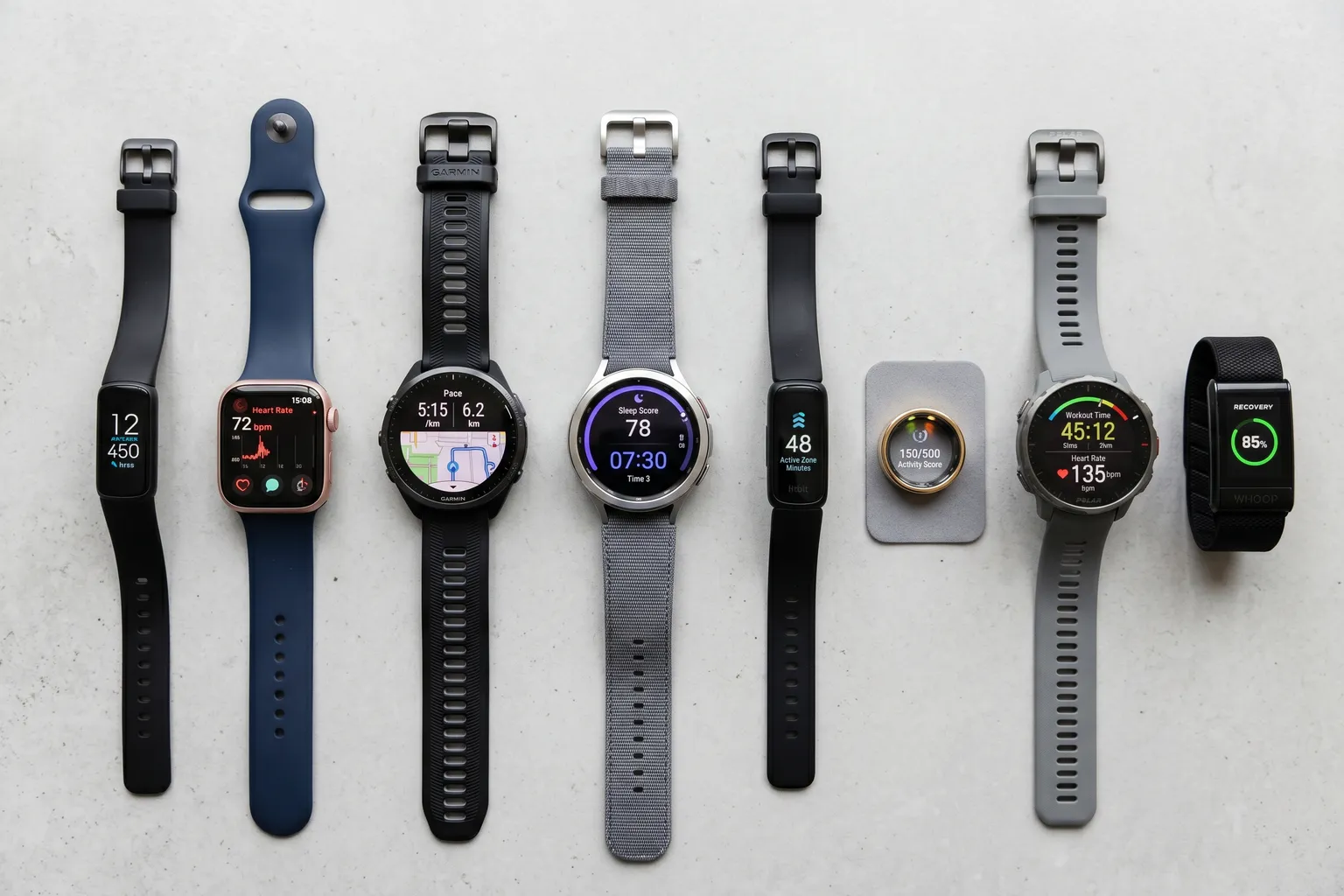
- The Fitbit Charge 6 is the best all-around fitness tracker under $150 — Google integration, built-in GPS, and solid health metrics without requiring a full smartwatch.
- Garmin Forerunner 265 is the pick for serious runners — the training load analysis and body battery metric are genuinely useful, not just marketing.
- Apple Watch SE (2nd gen) is the best Apple Watch value — crash detection, heart rate, and the full WatchOS ecosystem at a price that makes sense.
- Samsung Galaxy Watch 7's sleep coaching and body composition tracking make it the most health-data-rich option in the mid-price tier.
- If sleep tracking is your primary goal, the Oura Ring 4 gives you the best passive sleep data without needing to wear a watch to bed.
- Budget pick: Fitbit Inspire 3 at under $70 does the basics right and has 10-day battery life that makes daily charging optional.
Ten picks across every use case and budget. I’m not going to pretend every fitness tracker is equally worth your attention — they’re not. Let me tell you which ones actually matter and why.
Quick version: Fitbit Charge 6 for most people. Garmin Forerunner 265 if you run seriously. Apple Watch SE if you’re in the Apple ecosystem. Everything else is covered below with honest reasoning.
Quick-Pick Table
| Tracker | Price | Best For | Battery | GPS |
|---|---|---|---|---|
| Fitbit Charge 6 | ~$130–150 | All-around | 7 days | Built-in |
| Garmin Forerunner 265 | ~$299 | Runners | 13 days | Built-in |
| Apple Watch SE (2nd gen) | ~$135–195 | Apple users | 18 hours | Built-in |
| Samsung Galaxy Watch 7 | ~$159–220 | Android users | 40 hours | Built-in |
| Garmin Venu 3 | ~$349 | Active lifestyle | 14 days | Built-in |
| Fitbit Inspire 3 | ~$70–100 | Budget | 10 days | Connected |
| Oura Ring 4 | ~$299+ subscription | Sleep focus | Up to 8 days | No |
| Amazfit Band 7 | ~$50 | Ultra-budget | 18 days | No |
| Garmin Vivosmart 5 | ~$150 | Slim/discreet | 7 days | Connected |
| Apple Watch Series 10 | ~$399+ | Premium Apple | 18 hours | Built-in |
1. Fitbit Charge 6 — Best Overall Fitness Tracker
Buy on Amazon → | ~$130–150
The Charge 6 is the fitness tracker I’d recommend to most people without knowing anything else about them. It does everything a fitness tracker should do, it does it accurately, and it’s the right price.
Built-in GPS means no phone required for route tracking on runs or walks. Continuous heart rate monitoring, SpO2 (blood oxygen), EDA stress sensor, ECG app, irregular rhythm notifications. Six months of Fitbit Premium included — that’s $60 worth of health insights, sleep analysis, and guided programs.
The Google integration is legitimately useful if you’re an Android user. Google Maps shows turn-by-turn directions on the watch. Google Wallet lets you pay from your wrist. YouTube Music controls play through without your phone. For iPhone users, these features are less relevant, but the core fitness tracking still works fine.
Battery life is 7 days in normal use. That’s the sweet spot — charge it weekly and forget about it the rest of the time.
Where the Charge 6 falls short: no voice assistant, limited app selection, band comfort is average. It’s not trying to be a smartwatch. It’s trying to be the best fitness tracker at its price, and it is.
Specs: Built-in GPS | 40+ exercise modes | Heart rate + SpO2 + EDA + ECG | Google Maps/Wallet integration | Swim-proof to 50m | 7-day battery | S & L bands included
Best for: Anyone who wants comprehensive health tracking without the price or complexity of a full smartwatch.
2. Garmin Forerunner 265 — Best for Runners
Buy on Amazon → | ~$299
The Forerunner 265 is a running watch that happens to also be a solid fitness tracker. That’s the order of priorities, and it matters.
The AMOLED display is vivid and readable in sunlight. Garmin’s training load analysis tells you whether you’re building fitness or risking overtraining, and it actually learns your patterns over time. Body Battery is a composite score of HRV, sleep, and activity that gives you a rough sense of readiness — it’s more useful than it sounds.
Race predictor estimates your 5K, 10K, half, and full marathon times based on your training data. VO2 max is measured continuously. Recovery time advisor tells you how long to wait before your next hard effort.
Battery life: 13 days in smartwatch mode, 6 hours in GPS mode with music. That’s excellent. Charge it twice a week even if you run an hour every day.
The downside is price. $299 for a fitness tracker is a real number. But if running is your primary activity and you care about training structure, the Forerunner 265 gives you data that cheaper options don’t. For casual runners, the Fitbit Charge 6 is probably enough.
Specs: AMOLED display | Built-in GPS + GLONASS | Training load analysis | Body Battery | Race predictor | 13-day battery | Swim-proof to 50m | Music storage (500 songs)
Best for: Runners training for distance events, anyone who wants serious training analytics.
3. Apple Watch SE (2nd Gen) — Best Value Apple Watch
Buy on Amazon → | ~$135–195
If you’re in the Apple ecosystem, the Watch SE 2nd gen is the honest recommendation. The Series 9 and 10 add features most people don’t actually use enough to justify the premium.
What the SE has: crash detection, emergency SOS, fall detection, heart rate monitoring (not ECG), built-in GPS, swim-proofing. Full WatchOS integration — Apple Pay, notifications, Siri, third-party apps, family setup. The new S8 chip is fast enough that nothing feels slow.
What’s missing: ECG, blood oxygen sensor, always-on display. If those specifically matter to you, step up to Series 10.
Battery life is about 18 hours — so daily charging is reality. That’s a fundamental limitation of Apple Watch across all models.
For iPhone users who want a fitness tracker that works seamlessly with their phone, the SE is hard to beat at this price. For Android users, the SE is basically non-functional — get a Samsung Galaxy Watch 7 instead.
Specs: S8 chip | Built-in GPS | Heart rate + crash detection + fall detection | WatchOS 10 | 18-hour battery | Swimproof 50m | Available 40mm and 44mm
Best for: iPhone users who want solid fitness tracking with full Apple Watch functionality at a reasonable price.
4. Samsung Galaxy Watch 7 — Best for Android Users
Buy on Amazon → | ~$159–220
Samsung redesigned the Galaxy Watch 7 from the ground up with Wear OS 5 and One UI Watch 6. The result is a significantly more polished experience than previous Galaxy Watches.
The health tracking suite is genuinely impressive. BioActive sensor measures heart rate, ECG, blood oxygen, and now runs Advanced Sleep Coaching — analyzing 5 sleep stages and making personalized improvement recommendations. Body Composition analysis uses bioelectrical impedance to estimate skeletal muscle mass, body fat percentage, and water weight. That’s not standard even on $400 smartwatches.
Energy Score is a Samsung-specific take on Garmin’s Body Battery — a daily readiness score factoring in sleep quality, HRV, and activity. It’s useful in a “how do I actually feel today” context.
Battery life is 40 hours on the 44mm — roughly 1.5 days. You’ll charge it every night or every other night.
Best for Android users, specifically Samsung phone users who get deep integration. Works with other Android phones but some features require Samsung health ecosystem.
Specs: Wear OS 5 | BioActive sensor (heart rate + ECG + body composition) | 40hr battery | Built-in GPS | Advanced Sleep Coaching | 5ATM water resistance
Best for: Android users who want the most health data in a mid-priced smartwatch.
5. Garmin Venu 3 — Best Lifestyle Fitness Tracker
Buy on Amazon → | ~$349
The Venu 3 is for active people who don’t identify primarily as runners or athletes. It’s Garmin’s AMOLED lifestyle watch — looks like jewelry, tracks like a sports device.
The health features are comprehensive: sleep tracking with Sleep Score and nap detection, Body Battery, stress tracking, women’s health tracking, advanced heart rate metrics. Animated on-device workouts (yoga, strength, cardio) actually demonstrate proper form, which is more useful than just a timer.
Battery life is 14 days in smartwatch mode — significantly better than any Apple or Samsung watch. Built-in GPS.
Wheelchair mode with push detection is a meaningful accessibility addition. Disability-aware fitness tracking is underrepresented in wearables.
The price is real — $349 puts it against the Apple Watch Series 10 in terms of what you’re spending. The Venu 3 wins on battery and Garmin’s training ecosystem; the Series 10 wins on smartwatch features and ecosystem breadth.
Specs: AMOLED display | 14-day battery | Built-in GPS | Sleep Score + nap detection | Women’s health tracking | Animated workouts | Body Battery + stress
Best for: Active people who want serious health tracking in a watch they’d actually wear to dinner.
6. Fitbit Inspire 3 — Best Budget Fitness Tracker
Buy directly from Fitbit or major retailers | ~$70–100
The Fitbit Inspire 3 is the no-fuss, long-battery, “I just want to track my steps and sleep” option. And it’s good at exactly that.
Ten-day battery life. That’s the headline. You charge it maybe twice a week if you’re checking the screen constantly, or once a week with normal use. For people who find daily charging annoying, this matters.
It tracks steps, calories, distance, active minutes, 20+ exercise modes, sleep stages, heart rate, and stress. No built-in GPS — it uses your phone’s GPS for routes, which means routes only track when you bring your phone.
The Color Minimed display is AMOLED and readable. It’s a slim band, not a chunky watch. It looks like what most people picture when they hear “fitness tracker.”
For anyone who doesn’t want to spend $130+ but wants a real Fitbit experience, the Inspire 3 is the honest choice at this price tier.
Best for: Budget-conscious users, first-time fitness trackers, people who hate charging devices.
7. Oura Ring 4 — Best for Sleep Tracking
Available at ouraring.com | ~$299 + $5.99/month subscription
The Oura Ring is the outlier on this list. It’s a ring, not a wrist device, and it’s focused on recovery and sleep more than athletic performance.
Why it’s on this list: if sleep is your primary metric — if you’re using a fitness tracker mainly to understand your sleep quality and recovery — the Oura Ring gives you the best passive data of anything here. HRV data is continuous and collected at the finger, which is a physiologically better measurement site than the wrist for HRV.
The Readiness Score factors in sleep quality, HRV, resting heart rate, body temperature, and activity balance into one number. It’s actually predictive in a way that wrist-based devices aren’t quite there yet.
The subscription model ($5.99/month) is a legitimate con. The ring itself is $299 and then you’re paying monthly for data you already generated. That’s a real consideration.
Also: no GPS, no active workout tracking, no display. It’s purely a passive health monitor. If you want active fitness features, this isn’t it.
Best for: Sleep-focused health tracking, recovery monitoring, people who find wearing a watch uncomfortable at night. See our full Oura Ring 4 Review for a detailed breakdown of the accuracy data, subscription math, and exactly who it’s worth the cost for.
8. Amazfit Band 7 — Best Ultra-Budget Option
Available on Amazon | ~$35–50
Under $50 fitness tracker that actually works. The Amazfit Band 7 tracks steps, heart rate, SpO2, sleep, and stress across 120 sport modes. AMOLED display with always-on option. 18-day battery life.
It’s not going to match Garmin or Fitbit on accuracy, and the app is less polished. But for a first fitness tracker, or for someone who needs data without spending real money, the Band 7 delivers a legitimate experience.
The 18-day battery is genuinely remarkable at this price. Set it and forget it for two weeks.
Best for: Absolute budget buyers, people testing whether they’ll actually use a fitness tracker before spending more.
9. Garmin Vivosmart 5 — Slimmest Option
Available on Amazon | ~$120–150
The Vivosmart 5 is for people who specifically want something thin and discreet. It’s a proper fitness tracker with heart rate, SpO2, stress, Body Battery, and Pulse Ox — all in the slimmest band Garmin makes.
No built-in GPS (uses connected GPS from phone). Battery life is 7 days. The silicone band comes in small/medium and large.
If wrist comfort or aesthetics matter more than GPS or maximum feature density, the Vivosmart 5 is the right Garmin to consider.
Best for: People who find most fitness trackers too bulky, anyone who wants Garmin’s health ecosystem in a slim form factor.
10. Apple Watch Series 10 — Best Premium Option
Buy on Amazon → | ~$399–499+
The Series 10 is the thinnest Apple Watch ever made, with a larger AMOLED display, faster charging (10 minutes for 80%), and improved health sensors.
New in Series 10: sleep apnea detection (FDA-cleared), which is a significant clinical addition. If you’re concerned about sleep quality or have been told you might have sleep apnea, this feature alone may justify the premium.
All the standard Apple Watch features apply: ECG, AFib detection, crash detection, emergency SOS, blood oxygen, temperature sensing, always-on display. Full WatchOS ecosystem.
The 18-hour battery is unchanged — still daily charging territory. This is the fundamental Apple Watch limitation and it’s not going away.
For iPhone users who want the best possible wearable health device and don’t mind charging daily, the Series 10 is it. For everyone else, the SE is a better value.
Specs: AMOLED always-on display | Sleep apnea detection | ECG + AFib | Crash detection | Fast charging (10 min = 80%) | 18-hour battery | S9 SiP
Best for: Apple users who want maximum health features and the latest tech, especially those interested in sleep apnea monitoring.
Fitness Tracker Buying Guide
GPS: Built-in vs. Connected
Built-in GPS means the tracker can record routes and pace independently, without your phone. Important if you run or cycle without your phone. Fitbit Charge 6, Garmin Forerunner 265, Garmin Venu 3, Apple Watch, and Samsung Galaxy Watch 7 all have built-in GPS.
Connected GPS uses your phone’s GPS. Works fine if you always run with your phone. The Fitbit Inspire 3 and Garmin Vivosmart 5 use connected GPS.
Battery Life Reality
Battery life claims from manufacturers are usually for “basic smartwatch mode” — screen mostly off, notifications enabled, no continuous GPS. Real-world battery with regular GPS use, high screen brightness, and full heart rate monitoring will be shorter. Garmin’s GPS-on battery is usually 40–60% of their advertised smartwatch-mode battery.
Platform Compatibility
- Apple Watch: iPhone only. Non-negotiable.
- Fitbit: Works with iPhone and Android. Core features work on both.
- Garmin: Works with iPhone and Android. All features work on both.
- Samsung Galaxy Watch 7: Works with Android phones. Limited compatibility with iPhone.
Which Health Metrics Actually Matter
Heart rate: Useful for all activities. All trackers here do this.
HRV (heart rate variability): More meaningful than raw heart rate for recovery. Available on Garmin (HRV Status), Oura Ring, and some Fitbits.
ECG: Checks for AFib specifically. Apple Watch (SE excluded), Samsung Galaxy Watch 7, Fitbit Charge 6. Useful if you have cardiac concerns.
SpO2 (blood oxygen): Most trackers measure it. Useful for altitude acclimatization and general health monitoring.
Sleep staging: All trackers on this list measure sleep stages. Accuracy varies — Oura Ring is generally considered the most accurate for sleep specifically.
The Bottom Line
Most people: Fitbit Charge 6. It’s the best balance of accuracy, features, battery, and price.
Serious runners: Garmin Forerunner 265. Training analytics that actually inform your running.
iPhone users on a budget: Apple Watch SE. The full Apple Watch ecosystem at the right price.
Android users: Samsung Galaxy Watch 7. The best Android wearable health package at the mid-price tier.
For more on wearables and health tech, see our comparison of Apple Watch vs Garmin and our roundup of the best noise-cancelling headphones if you’re building out your exercise tech setup.