
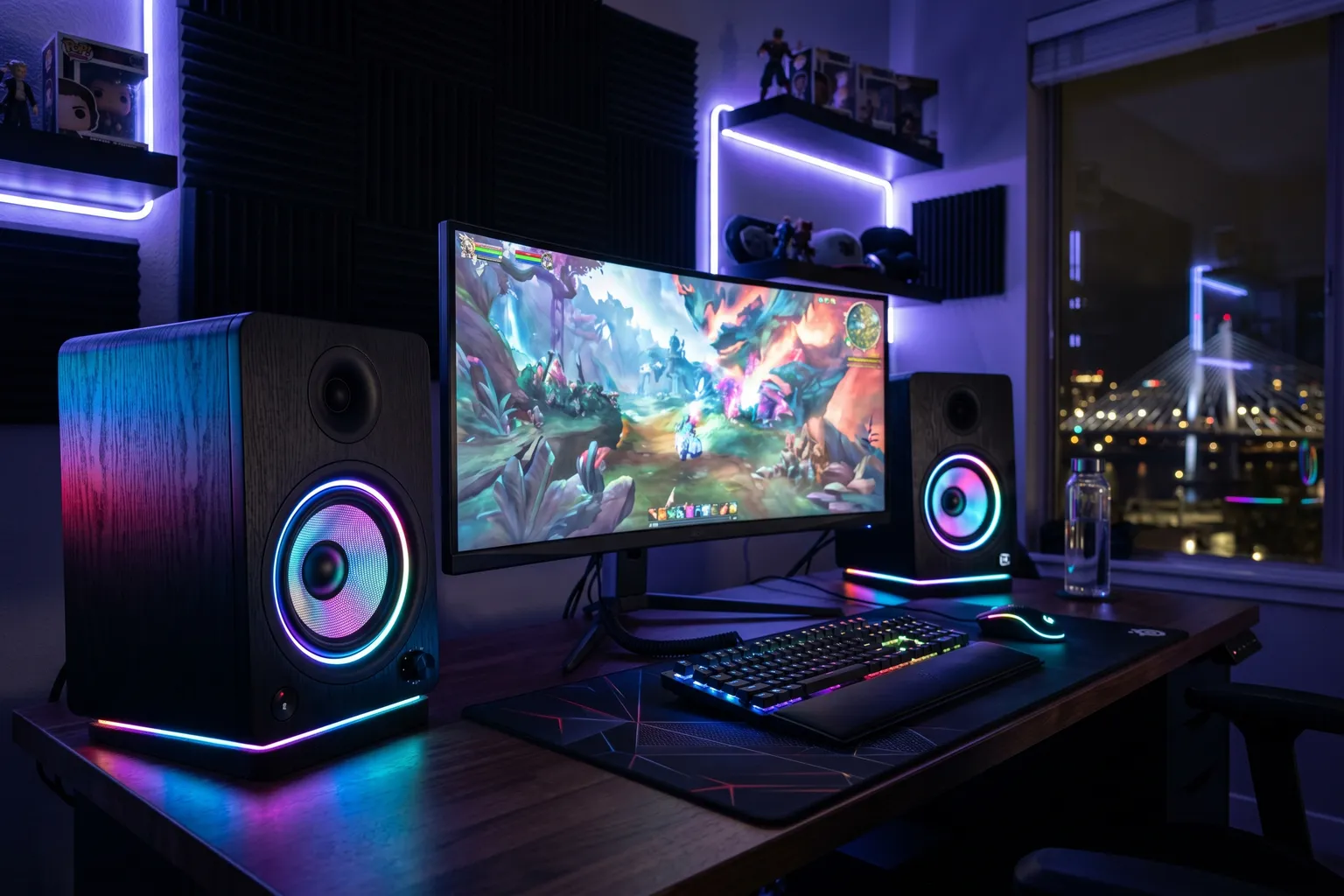
- The Razer Leviathan V2 is the best compact gaming soundbar — THX Spatial Audio, Chroma RGB, and actual bass from the subwoofer at a reasonable footprint.
- The Logitech G560 is still the best 2.1 gaming speaker system for immersion — the rear-wall RGB projection is actually useful for awareness in games.
- Creative Pebble Plus is the best budget pick — $35–45 for desktop speakers that sound better than anything in their class.
- For critical listening and music alongside gaming, the Audioengine A2+ outclasses anything with 'gaming' in the name.
- Most people don't need 5.1 or 7.1 surround speakers for gaming — virtual surround through a good stereo setup plus HRTF processing works better in most rooms.
Gaming speakers are a weird category. The “gaming” label adds RGB, “immersive spatial audio” marketing, and sometimes a $50 price premium over speakers that sound identical from an audio company. Let me be honest about what’s worth it.
Quick-Pick Table
| Speaker | Type | Price | Best For |
|---|---|---|---|
| Razer Leviathan V2 | Soundbar + sub | ~$150–200 | Compact desk, THX audio |
| Logitech G560 | 2.1 stereo | ~$100–180 | Immersive gaming, RGB |
| Creative Pebble Plus | 2.0 + sub | ~$35–45 | Budget, small desk |
| Audioengine A2+ | Stereo bookshelf | ~$269 | Audio quality first |
| Logitech Z207 | 2.0 stereo | ~$30–50 | Entry level, budget |
| SteelSeries Arena 9 | 5.1 surround | ~$250–300 | Large space, full surround |
| Klipsch ProMedia 2.1 | 2.1 stereo | ~$130–160 | Best passive value |
1. Razer Leviathan V2 — Best Compact Gaming Soundbar
Buy on Amazon → | ~$150–200
The Leviathan V2 is the compact gaming speaker solution. One bar that sits in front of your monitor plus a small subwoofer that hides under your desk — takes up far less real estate than a full 2.1 satellite system while delivering similar audio performance.
THX Spatial Audio is the differentiator. The five high-excursion drivers and beamforming tweeter array create a wider soundstage than you’d expect from a single bar. For gaming — especially single-player games with directional audio — it works noticeably better than budget stereo desktop speakers.
The subwoofer is small (9.4" × 7.4") but delivers actual low-end. Not “boom” bass, but the presence bass that makes explosions and music feel like more than tinny noise.
Bluetooth 5.2 means you can connect your phone wirelessly for music without touching cables. Razer Chroma RGB on the front bar for aesthetics.
The con: at $150–200, it’s expensive for a soundbar. And “THX Certified” branding is somewhat marketing-forward. If pure sound quality per dollar is your metric, the Klipsch ProMedia 2.1 is a better speaker for less. But for desk footprint efficiency, the Leviathan V2 wins.
Specs: 5-driver soundbar | Compact subwoofer | THX Spatial Audio | Bluetooth 5.2 | Razer Chroma RGB | USB-C + 3.5mm | Wireless control pod
Best for: Desk setups where footprint matters, gaming focused audio with compact form factor.
2. Logitech G560 — Best 2.1 Gaming Speaker System
Buy on Amazon → | ~$100–180
The G560 is the gaming speaker with the most gaming-specific features. And some of them are actually good.
The rear-wall RGB projection is the headline — the two satellite speakers project light onto the wall behind them, and with LIGHTSYNC integration, that lighting syncs to in-game events (explosions, damage, health status in compatible games). It sounds gimmicky but it’s genuinely useful for peripheral vision awareness and ambient immersion in games like Far Cry, Cyberpunk, or any open-world game with dynamic environments.
DTS:X Ultra is the spatial audio processing. It works for gaming — better positional cues than basic stereo. The subwoofer delivers solid bass for the size.
Bluetooth + USB + 3.5mm input means you can connect multiple devices simultaneously and switch between them.
The G560 is not an audiophile speaker. The frequency response is tuned for gaming enjoyment rather than accuracy — slightly boosted bass, slightly emphasized highs for gunshots and footsteps. For music, it’s decent but not exceptional. For gaming, it’s one of the better designed systems at this price.
Specs: 2.1 (two satellites + subwoofer) | DTS:X Ultra 7.1 virtual surround | LIGHTSYNC RGB rear projection | Bluetooth + USB + 3.5mm | 240W peak | LIGHTSPEED wireless compatible
Best for: Gamers who want immersive audio AND lighting integration, desk setups with wall space behind them.
3. Creative Pebble Plus — Best Budget Speakers
Available on Amazon | ~$35–45
Look — the Creative Pebble Plus is $35–45 and sounds genuinely good for its price. Not “good for the price” as a hedge, but actually good in absolute terms compared to anything else under $50.
The 2.0 satellite design sits your desk without sub (though the Plus version includes a small sub via USB power). Down-firing driver design puts the speaker on the desk itself, which uses the desk surface for acoustic coupling — it’s a clever solution for small speakers.
For a student desk, a bedroom gaming setup, a secondary work computer, or literally anyone who needs desktop audio and doesn’t want to spend money — this is the answer.
Will it match the Leviathan V2 or G560? No. But it sounds notably better than the bundled speakers on any monitor, and it costs $35.
4. Audioengine A2+ — Best for Audio Quality
Available from Audioengine and Amazon | ~$269
If you care about actual sound quality — for music listening, for accurate game audio, for not having boosted frequencies masking what the audio is actually doing — the Audioengine A2+ is the answer.
The A2+ is a bookshelf speaker, not a “gaming speaker.” No RGB. No virtual surround mode. What it has: high-quality analog amplification, 15-watt amp in each speaker, 2.75" Kevlar woofer and 3/4" silk tweeter. The sound is accurate, wide, and detailed.
Built-in USB DAC means it connects directly to your computer via USB for proper digital-to-analog conversion, bypassing your motherboard’s audio.
If you’re the person who plays Spotify through their gaming speakers and feels something is wrong — the A2+ is what fixes that. It costs more than the G560 and has zero gaming-specific features, but it sounds better on music and is accurate enough for gaming audio to make directional cues clearer.
Best for: Audiophiles who also game, people who value music quality alongside gaming use.
5. Logitech Z207 — Entry-Level Budget Pick
Available on Amazon | ~$30–50
Simple desktop stereo speakers with Bluetooth. Two drivers, no subwoofer, 10W total output. Fine for a budget setup where speakers are secondary — a streaming PC, a casual gaming station, a home office where you just want some audio.
The Z207 doesn’t do bass. It doesn’t have spatial audio features. But it works, it’s Logitech quality, and it sounds notably better than monitor speakers.
6. SteelSeries Arena 9 — Best Surround Sound Setup
Available on Amazon | ~$250–300
The Arena 9 is the desk-based 5.1 surround speaker system — five satellite speakers plus a subwoofer in a configuration that genuinely puts sound at different positions in your space. Unlike virtual surround, the Arena 9 places speakers at your actual sides and behind you.
This only makes sense if you have the desk space and room layout to position the speakers correctly. Satellites behind you require cable runs or wireless setup. In a small room or on a small desk, 5.1 placement doesn’t work well and virtual surround through a good stereo setup is actually better.
For large dedicated gaming rooms where placement is possible, the Arena 9 creates an immersive audio environment that virtual surround cannot fully replicate.
7. Klipsch ProMedia 2.1 — Best Value Passive System
Available on Amazon | ~$130–160
Klipsch’s ProMedia 2.1 is a classic for a reason. The THX-certified system has horn-loaded tweeters that provide the kind of sound dispersion normally found in speakers twice the price. The subwoofer is properly tuned — not just bass boosted.
Klipsch doesn’t add RGB or gaming branding to this, which means it’s priced on audio merit. At $130–160, it outperforms gaming-branded 2.1 systems in the same price range on audio quality. The tradeoff: no spatial audio processing, no Bluetooth, analog only.
For someone who cares about sound first and gaming features second, the ProMedia 2.1 is the value play.
What Actually Matters When Buying Gaming Speakers
2.0 vs. 2.1 vs. 5.1
2.0 (stereo): Two speakers, no subwoofer. Sufficient for most gaming. Takes minimal desk space.
2.1: Two satellites plus a subwoofer. The subwoofer can go on the floor or under the desk. Adds real bass impact. This is the sweet spot for most gaming setups.
5.1 or 7.1: Five or seven satellites plus a subwoofer. Requires room positioning to work properly. Overkill for most desk setups; better for dedicated home theater gaming on a couch.
Virtual Surround vs. Physical Surround
Every “gaming speaker” at this price point that claims 5.1 or 7.1 is delivering virtual surround — using signal processing to simulate directional audio from 2 physical speakers. It’s not bad, but it’s not the same as having speakers physically positioned around you.
For competitive gaming, good stereo speakers with a headset is often the better choice anyway.
RGB Is Optional, Not a Feature
RGB on speakers doesn’t improve audio. If you want it for aesthetics, fine — the Leviathan V2 and G560 both do RGB well. If you don’t care about RGB, buy based on audio quality and price instead.
Bottom Line
Compact desk: Razer Leviathan V2 — soundbar form factor with actual subwoofer bass.
Best gaming experience: Logitech G560 — the RGB projection and DTS:X spatial audio make games more immersive.
Best budget: Creative Pebble Plus — seriously good for $35.
Best audio quality: Audioengine A2+ — for people who care more about how their music sounds than gaming-specific features.
For audio that goes on your head instead of on your desk, check out our best gaming headsets roundup. And for the full desktop audio setup context, see our best gaming desk picks.