
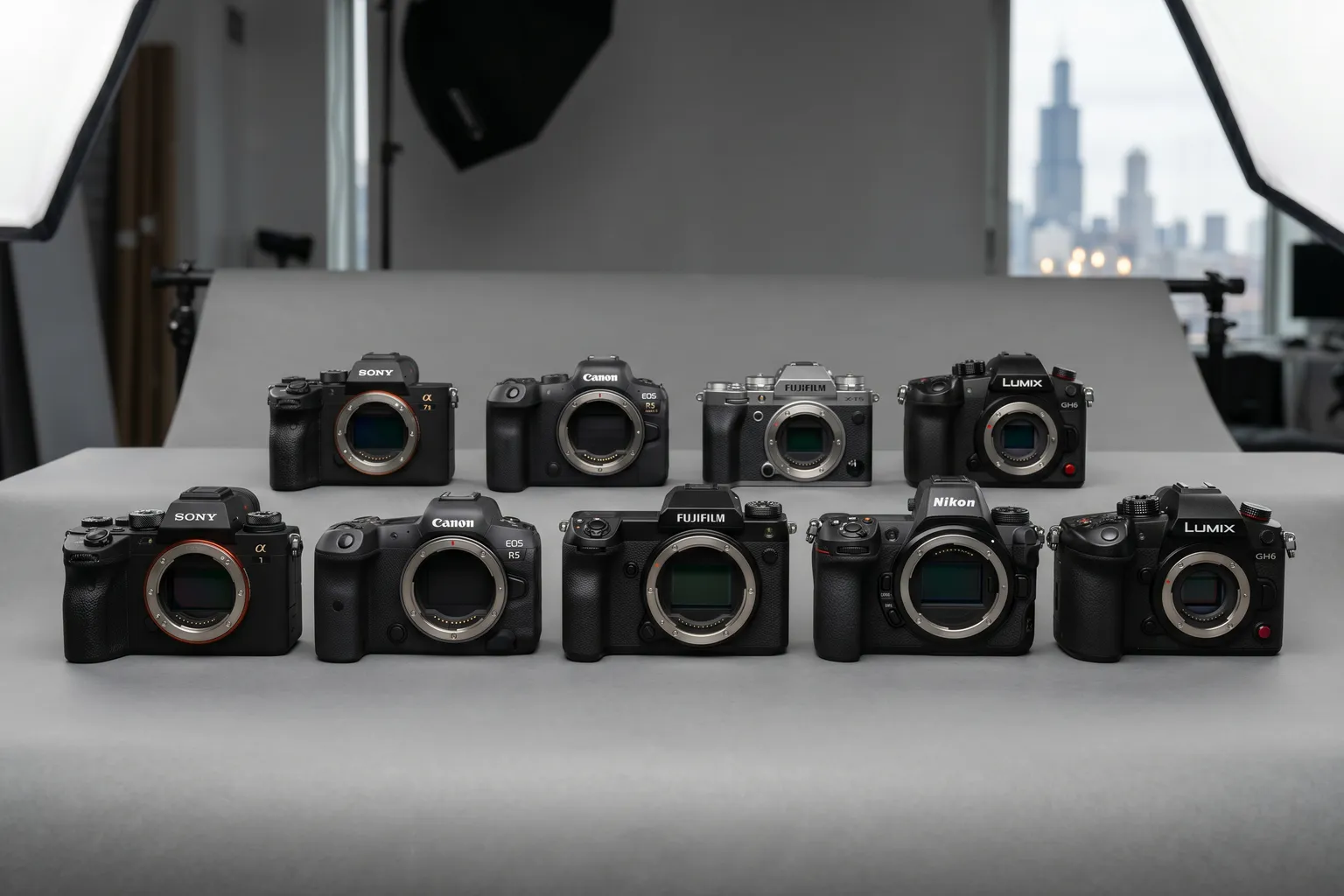
- Sony A7C II is the best all-around mirrorless for serious shooters who want full-frame without the size — 33MP, class-leading autofocus, and a body that doesn't announce itself on the street
- Fujifilm X-S20 is the pick for content creators who need all-day video capability with a great APS-C sensor — the battery life alone sets it apart from the competition
- Canon R50 is the best entry-level mirrorless under $700 — simple enough to learn on, capable enough to grow with, and the Canon RF ecosystem has legs
- Don't buy more camera than you'll use — the difference between a $600 body and a $2,200 body shows up in very specific situations that most shooters will never encounter
- APS-C cameras have closed the gap on full-frame for most real-world shooting — the Fujifilm X-T50's 40MP sensor produces files that will embarrass cameras that cost twice as much
The mirrorless camera market has gotten genuinely good. And genuinely confusing.
In 2026, there are excellent mirrorless cameras at every price point from $600 to $6,000. APS-C sensors that would have embarrassed a pro body five years ago. Full-frame cameras shrunk down to a size you’d actually carry. Autofocus systems that track a subject’s eye through a crowd and never let go.
The problem isn’t finding a good camera. The problem is figuring out which good camera is right for you — your shooting style, your budget, the lenses you’ll actually buy, the footage you’re trying to pull. I’ve cut this list to eight picks that cover the real decision points. These aren’t the eight most technically impressive cameras on the market. They’re the eight I’d actually recommend to someone asking me face-to-face.
Quick Comparison: Best Mirrorless Cameras 2026
| Camera | Sensor | Resolution | Price (Body) | Best For |
|---|---|---|---|---|
| Sony A7C II | Full-Frame | 33MP | ~$2,200 | All-around best, serious shooters |
| Fujifilm X-S20 | APS-C | 26MP | ~$1,300 | Content creators, vloggers, travel |
| Canon EOS R50 | APS-C | 24MP | ~$600 | Beginners, upgrade from smartphone |
| Sony ZV-E10 II | APS-C | 26MP | ~$750 | Video-first, vlogging |
| Fujifilm X-T50 | APS-C | 40MP | ~$1,300 | Image quality + film simulation lovers |
| Canon EOS R8 | Full-Frame | 24MP | ~$1,300 | Full-frame entry, Canon ecosystem |
| Nikon Z50 II | APS-C | 21MP | ~$900 | Nikon fans, stills-focused shooters |
| OM System OM-5 | Micro Four Thirds | 20MP | ~$900 | Weather-sealed compact, outdoor use |
1. Sony A7C II — Best All-Around Mirrorless Camera
Price: ~$2,200 body | Check on Amazon
I’ll be honest about what the A7C II is: it’s the camera I’d buy if someone handed me $2,200 and told me to pick one mirrorless body to cover everything. That’s not a casual endorsement. I have a low tolerance for cameras that are impressive on paper and annoying in practice.
The A7C II is neither. It’s a 33-megapixel full-frame camera packed into a body that’s barely larger than some APS-C cameras. Sony achieved this by rethinking the chassis — flipping the electronic viewfinder to the corner instead of the center hump, which lets the body sit flat in a bag and makes it genuinely inconspicuous on the street. It doesn’t scream “expensive camera.” That matters more than people admit.
The autofocus is the other thing. Sony’s Real-time Recognition AF in this camera is the best subject tracking I’ve seen at this price point. Human eye detection, animal eye detection, insect detection – it tracks what you’re pointed at and doesn’t get confused when your subject ducks behind something and reappears. For sports, wildlife, kids who won’t sit still, events – the A7C II’s AF removes an entire category of failure from your shots.
Specs that matter:
- 33MP full-frame BSI CMOS sensor
- ISO 100-51200 (expandable to 409600)
- 10fps continuous shooting
- 4K video up to 60fps (with 10-bit color in S-Log3)
- 5-axis in-body stabilization (5.5 stops compensation)
- Fully articulating touchscreen
- Dual card slots (CFexpress Type A + SD)
The dual card slot setup – one CFexpress Type A, one SD – is a workflow detail that matters once you’re shooting anything serious. You can run simultaneous backups, or use CFexpress for video and SD for JPEG backup. Small thing that separates the A7C II from cheaper bodies.
What doesn’t work: The battery life is typical Sony, which means “not great.” Plan on two batteries minimum for a full day. The menu system is Sony’s, which is functional but deeper than it needs to be. And the 33MP files are large – if your computer is old, you’ll feel it during editing.
At $2,200, it’s the most expensive body on this list. But for photographers who actually use their camera – travel, portraits, street, events, the occasional video project – the A7C II punches above its price class. It’s the best all-around mirrorless camera you can buy right now without going to a much larger body.
2. Fujifilm X-S20 — Best for Content Creators and Video
Price: ~$1,300 body | Check on Amazon
The X-S20 is the Fujifilm camera I recommend most often. Not the most technically impressive in their lineup – the X-T50 has higher resolution, and the X-H2S has better video specs – but the X-S20 hits a specific sweet spot that almost nobody talks about: it’s the best battery life in any APS-C mirrorless at this price.
810 shots per charge. In the mirrorless world, that’s a remarkable number. Competing cameras from Sony and Canon are pulling 250-400 shots from a charge. The difference is real when you’re shooting all day without access to a charging station, which is every travel day I’ve ever had.
Beyond battery life: the X-S20 shoots 6.2K open gate video internally, handles 4K/30fps without cropping, and has Fujifilm’s film simulation modes baked into the video pipeline – so your footage comes out of the camera with a Velvia or Classic Chrome look that would cost hours in DaVinci Resolve to approximate. That’s a real workflow advantage for content creators who don’t want to live in post-production.
The autofocus has improved significantly from previous X-series bodies. Subject detection works reliably for humans. It’s not quite at Sony’s level for tracking fast-moving subjects, but for YouTube videos, talking-head content, and travel footage, it’s more than adequate.
What works:
- Battery life nobody else at this price comes close to
- Fujifilm film simulations are the best in-camera color science available
- IBIS (up to 7 stops with compatible lenses) makes handheld video usable
- Subject/face tracking AF is solid for the price
- Compact and well-built body
What doesn’t: The X-S20’s autofocus still trails Sony for tracking sports or wildlife. The 26MP sensor is excellent but not a resolution leader – the X-T50 at the same price point offers 40MP if stills resolution is your priority. And the joystick-based menu navigation will feel unfamiliar coming from Canon or Sony.
For content creators, travel shooters, and YouTubers who want the best video camera under $1,500 without going into Sony mirrorless territory – this is the pick.
3. Canon EOS R50 — Best Entry-Level Mirrorless Camera
Price: ~$600 body | Check on Amazon
The R50 is the camera I point beginners toward, and I don’t feel like I’m compromising by doing it.
At $600 for the body – often available for $550 on sale – you get Canon’s Dual Pixel CMOS AF II, which is genuinely one of the best autofocus systems available at any price in this category. The face detection and eye tracking work. The 24MP APS-C sensor produces clean images through ISO 3200, adequate through ISO 6400. And the menu system is the most intuitive Canon has ever shipped.
The RF-S mount is also Canon’s current standard – this camera will work with every RF lens Canon makes and releases going forward. That’s the right ecosystem to be in if you’re building a kit over time. The EF lens adapter works well too if you have older Canon glass.
For video: 4K at 30fps (with a slight crop) or 1080p at 60fps. The flip-out touchscreen makes vlogging possible. There’s no IBIS, which limits handheld video performance – but for static shots, talking heads, and tripod work, it’s perfectly capable.
What this camera doesn’t have: IBIS, a headphone jack (you get a mic input but no monitoring), a second card slot, and the high-speed burst modes that more expensive bodies offer. None of that matters for the typical beginner use case.
The real reason to buy it: You’ll learn on it, outgrow it eventually, and when you do – you’ll have a clear upgrade path within the Canon RF ecosystem without starting over on lenses. The R8 body sits right above it at $1,300 (full-frame), and Canon’s RF lens lineup keeps getting better. The R50 is the right starting point.
4. Sony ZV-E10 II — Best Vlogging APS-C Camera
Price: ~$750 body | Check on Amazon
The ZV-E10 II is Sony’s vlogging-first APS-C body, and it does what it says on the box. Completely flippable front-facing screen for solo creators, Sony’s Real-time Recognition AF for tracking your face even when you wander, and a product showcase mode that automatically shifts focus between your face and whatever you’re holding up for the camera.
The 26MP sensor (the same stack as the A6700 series) is excellent in the APS-C class. 4K video is clean. The autofocus is – and I want to be specific here – the best autofocus available in an APS-C vlogging camera at this price. It’s not close.
What’s missing compared to the X-S20: no IBIS. Sony is relying on digital stabilization for handheld video, which works but introduces a slight crop and doesn’t match optical stabilization. For vlogging applications where you’re mostly stationary or using a gimbal, it’s not a dealbreaker. For walking-and-talking style content – it matters.
The battery life is also Sony-typical: modest. A second battery is not optional.
For pure talking-head YouTube content and product review channels, the ZV-E10 II is probably the smartest buy under $1,000. The AF is the difference-maker.
5. Fujifilm X-T50 — Best Image Quality Per Dollar
Price: ~$1,300 body | Check on Amazon
Here’s the camera that genuinely surprised me. Forty megapixels in an APS-C body at $1,300. The X-T50 uses the same 40MP X-Trans V sensor as Fujifilm’s flagship X-T5, and the image quality gap between this and cameras costing $1,000 more is much smaller than it has any right to be.
The film simulation dial – a physical mode dial with film simulation presets baked in, right there on the top of the camera – is the best user interface decision Fujifilm has made in a decade. You flip the dial to Provia, Velvia, Classic Chrome, Acros. Done. No menus. Your JPEGs out of camera look like you spent an afternoon in Lightroom.
For photographers who prioritize still image quality over video specs, the X-T50 is the answer. The 40MP files resolve extraordinary detail. Landscape, portraiture, travel – it’s a dedicated photography tool.
The video situation is the caveat. The X-T50 does 4K, but it overheats during long recording sessions and lacks some of the video ergonomics that the X-S20 handles better. If your primary output is video, get the X-S20. If you want the best stills camera in the $1,300 APS-C bracket – this is it, and it’s not especially close.
6. Canon EOS R8 — Best Full-Frame Value
Price: ~$1,300 body | Check on Amazon
The R8 is Canon’s answer to a question a lot of people ask: is full-frame available under $1,500? The answer is yes, and the R8 is a genuinely capable camera for the price. Same 24.2MP full-frame CMOS sensor as the significantly more expensive R6 Mark II. Dual Pixel CMOS AF II. 4K at 60fps. Lightweight body.
The tradeoffs are real. No IBIS – you’re relying on lens stabilization and digital modes for video stability. Single card slot. Modest battery life. The burst mode is limited. And the body feels lighter and cheaper than Canon’s higher-end R bodies, because it is.
But for someone who wants full-frame image quality and is deeply invested in (or planning to invest in) Canon’s RF lens ecosystem, the R8 is the most accessible entry point available. The lenses matter as much as the body, and Canon’s RF glass is excellent. An R8 paired with the RF 35mm f/1.8 IS is a street and travel setup that performs well above its combined price.
7. Nikon Z50 II — Best APS-C Mirrorless for Nikon Users
Price: ~$900 body | Check on Amazon
I’ll be direct: I’d recommend the Z50 II to Nikon shooters specifically. If you don’t have Nikon glass and aren’t committed to the Z-mount ecosystem, the Sony ZV-E10 II and Fujifilm X-S20 are more compelling at similar prices for their respective strengths.
For Nikon users: the Z50 II is a genuine upgrade over the original Z50. Better autofocus – Nikon’s subject detection AI has improved substantially, and the eye/face tracking is now competitive with what Canon and Sony offer. Better video specs. The color science Nikon shooters expect. And full compatibility with the growing Z-mount native lens lineup plus FTZ adapter for older F-mount glass.
The 21MP sensor isn’t the resolution leader in this bracket – the Fujifilm X-T50 offers 40MP at the same price – but it produces very clean files and the dynamic range is excellent for a 2024-generation APS-C chip.
For all-day street shooting, travel, and events, it’s a solid performer. Not the camera I’d recommend first to someone with no ecosystem commitments, but a strong choice for shooters already in Nikon’s world.
8. OM System OM-5 — Best Weather-Sealed Compact Mirrorless
Price: ~$900 body | Check on Amazon
The OM-5 is a niche recommendation – but the right camera for a specific type of shooter who won’t find better elsewhere.
If your shooting happens outdoors, in weather, in situations where you’d hesitate to pull out a Sony or Fujifilm body – the OM-5 is built for it. IP53 weather sealing. Freeze-proofed to -10°C. Small enough to fit in a hiking daypack without reorganizing everything around it. The Micro Four Thirds form factor means the lenses are smaller too, which matters when you’re carrying everything on your back.
The 5-axis IBIS is among the best ever put in a camera this size: up to 7.5 stops of compensation. Handheld shots in situations that would produce blurry results from other cameras. The 50MP high-resolution shot mode (computational stacking while handheld) is genuinely impressive for landscape work.
What you’re trading: Micro Four Thirds sensor size means higher noise at high ISOs compared to APS-C or full-frame bodies. At ISO 3200 and above, the gap is noticeable. For outdoor photography in decent light – which is most hiking and adventure shooting – it’s not a real limitation. For low-light indoor or night work, you’ll want one of the APS-C or full-frame options above.
The OM-5 is the camera for trail runners, hikers, kayakers, and anyone whose camera gets rained on. Genuinely nobody else does this particular thing as well at this price point.
How to Actually Choose
Here’s the decision tree I actually use.
Tight budget (under $700)? Canon R50. Done.
Shooting mostly video / YouTube / vlogs under $1,000? Sony ZV-E10 II.
Shooting video and stills, $1,000-$1,500, want best-in-class video? Fujifilm X-S20.
Stills-focused, want maximum resolution in the APS-C bracket? Fujifilm X-T50.
Want full-frame on a budget, already in Canon’s ecosystem? Canon R8.
In Nikon’s ecosystem, want a capable APS-C body? Nikon Z50 II.
Outdoor shooter, weather is a real concern? OM System OM-5.
Want the best all-around mirrorless camera money can buy in this range, stills and video? Sony A7C II. It costs $2,200. It’s worth it if you’ll use it seriously.
The market in 2026 is genuinely good across the board. The floor has risen, the value has improved, and the cameras that used to require professional budgets are increasingly accessible. There’s no bad choice among these eight – only choices that are more or less suited to how you actually shoot.