
Starting a smart home is the easy part. The friction comes three months later when you’ve accumulated a dozen devices across two apps, your automations are fighting each other, and you’re not sure why the lights turn on at 3am.
Good starter kits avoid that by setting you up with a coherent ecosystem from the start. The goal isn’t the most stuff — it’s the right starting point.
Understanding Smart Home Ecosystems Before You Buy
Before picking a kit, understand which ecosystem you’re buying into.
Alexa (Amazon): Widest third-party device compatibility. Best automation options. Works best with Amazon’s own hardware. If you don’t have a smartphone preference and want maximum device choice, Alexa is the most flexible.
Google Home: Best if you live in Google’s apps (Calendar, Maps, Gmail, YouTube Music). Smart display experience is strong with the Nest Hub. Less third-party device depth than Alexa.
Apple HomeKit: Best if you have an iPhone and Mac. Most privacy-focused. Fewest compatible devices. Excellent if you’re fully in Apple’s ecosystem; frustrating if you’re not.
Matter (All): The cross-platform protocol. New devices increasingly support Matter, meaning they work with any major ecosystem. If you start with Alexa and later add an iPhone, Matter devices you already own will work with HomeKit.
1. Amazon Smart Home Starter Kit — Best All-in-One Bundle
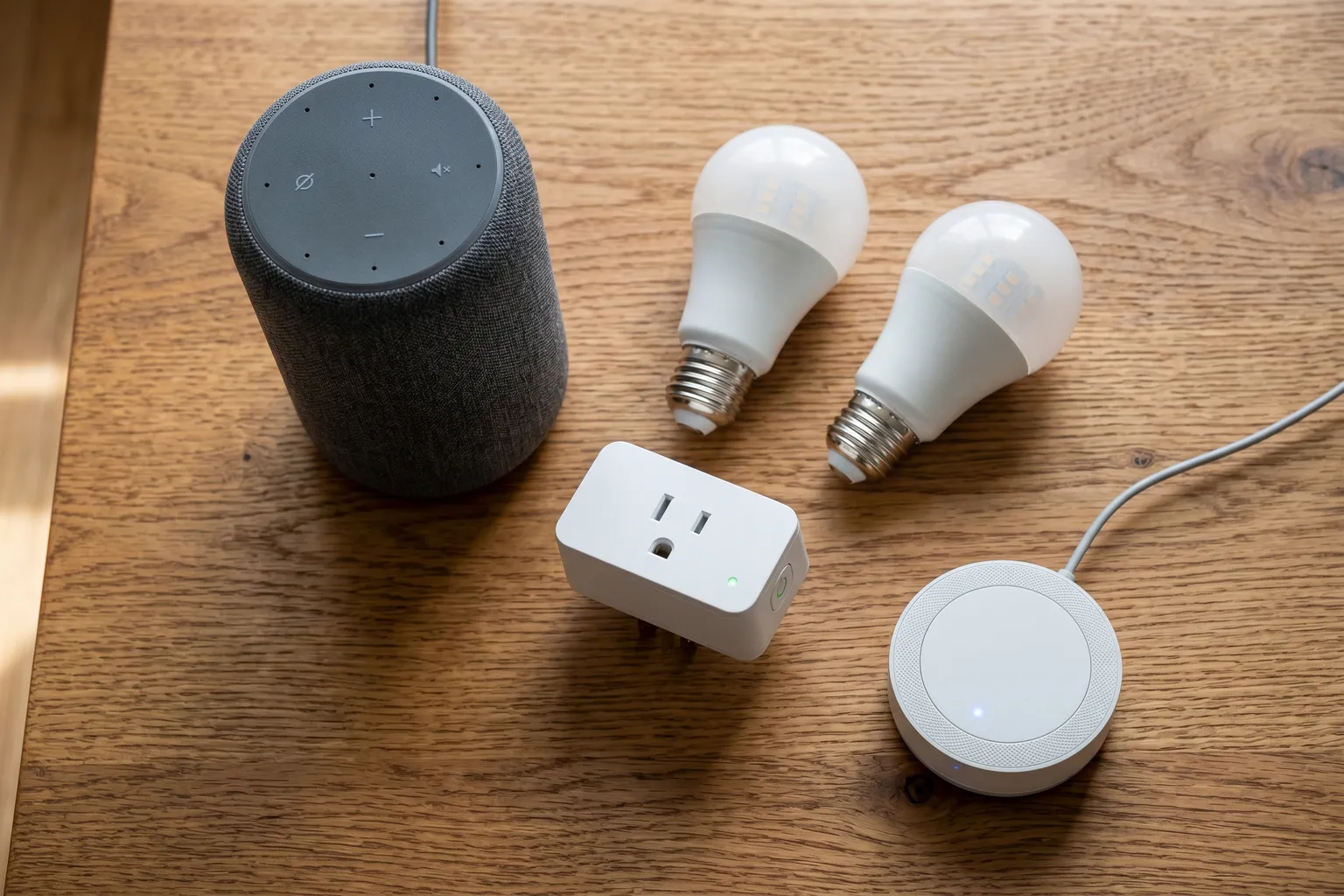
Amazon’s Smart Home Starter Kit bundles an Echo Hub with smart plugs and Amazon Basics smart bulbs. It’s the most purpose-built starter kit on this list.
The Echo Hub is the centerpiece — an 8-inch wall-mountable display that shows your home’s status at a glance, controls devices with a touch, and works as an Alexa voice control point. It’s not just a speaker you talk to; it’s a visual dashboard. Having that immediately changes how you interact with your smart home.
The smart plugs and bulbs round out the immediate usability: plug in a lamp, connect it to Alexa, and you have your first automated light in ten minutes. The bulbs support color and warmth adjustment. The plugs work for anything: a fan, a coffee maker, a floor lamp.
Where Amazon’s kit wins over assembling the same pieces separately: the bundle includes the Zigbee coordinator built into the Echo Hub, so future Zigbee devices don’t need a separate bridge. That’s a real setup simplification that other kits don’t match.
Honest consideration: This kit is Alexa-first and doesn’t include a thermostat, doorbell, or security components. It’s a starting point, not a complete setup. But as a starting point, it’s the best one if you’re Alexa-neutral.
2. Google Nest Bundles — Best for Google-First Households
From $79.99 on Amazon — Google Nest Mini + Chromecast Bundle
Google’s smart home bundles vary more than Amazon’s. The base bundle pairs a Nest Mini speaker with a Chromecast device, covering voice control and TV casting — a practical entry if your primary use case is controlling music and TV from voice commands.
For a more complete smart home starter, look beyond the bundled products and build a Google-native kit:
- Google Nest Hub Max ($229.99) as your hub display
- Google Nest Thermostat ($129.99) if temperature control matters
- Google Nest Cam ($179.99 indoors) for security
The Nest ecosystem excels at integration between Nest devices. Nest cameras, thermostats, and doorbells talk to each other natively in ways that feel cohesive. The Nest Thermostat’s learning features are genuinely good – it figures out your schedule and adjusts automatically.
Where Google falls short: fewer third-party smart home devices compared to Alexa, and the automation engine has caught up but isn’t quite at Alexa’s depth. If you have mixed-brand smart home devices (Arlo cameras, August locks, SmartThings sensors), Alexa is more forgiving.
3. Philips Hue White and Color Ambiance Starter Kit — Best Lighting Entry
$149.99 (4-bulb A19 kit) on Amazon
The Philips Hue starter kit is a different type of entry point — it’s specifically about smart lighting, and it’s the best smart lighting you can buy.
The kit includes four White and Color Ambiance bulbs (16 million colors, 800 lumen daylight equivalent) plus the Hue Bridge, which connects to your router and provides the hub for all your Hue devices. The Bridge is the key piece — it adds local processing, Matter support for cross-platform use, and access to the full Hue feature set.
What makes Hue worth the premium over $15 smart bulbs: the color accuracy and dimming smoothness are noticeably better. Hue bulbs dim to very low levels without flickering. The warm-to-cool color range is wide and accurate. The Hue app’s ambiance scenes and dynamic lighting effects are more refined than competitor apps. If you care about the quality of your home lighting, Hue is in a different tier.
The Hue Bridge supports up to 50 lights. Expand with additional bulbs, light strips, gradient tubes, or outdoor fixtures as your budget allows. The whole Hue ecosystem uses Zigbee, so everything connects reliably without cloud dependency for local control.
Honest consideration: $150 for four bulbs and a bridge is real money. The value builds as you expand to more lights — the Bridge cost amortizes over time. If you just want to make one lamp smart, start with a $30 Hue bulb and a Hue Bridge separately, or use a cheaper smart bulb entirely.
Which Starter Kit Should You Buy?
You want a comprehensive Alexa starting point: Amazon Smart Home Starter Kit ($199.99). Echo Hub plus smart devices in one box.
You’re already Google-native: Google Nest Hub Max + Nest Thermostat. Not a single bundle, but the combination sets you up well.
Smart lighting is your priority: Philips Hue starter kit ($149.99). Best light quality, expandable ecosystem.
Lowest cost entry: Echo Dot ($49.99) + 2-3 smart plugs (~$15-25 each) and figure out what else you need after you’ve used it.
Related Reading
- Best Smart Home Hubs 2026 — dedicated hub options beyond what’s in starter kits
- Best Smart Speakers 2026 — standalone smart speakers to expand your setup